Showing posts with label labour. Show all posts

Sunday, June 14, 2009

The Battle for Resource...

I have long argued that the big issue underlying the financial and economic crisis is the relationship between labour and the availability of commodities in relation to the increasing supply of labour. At the heart of my thesis is that, where there are constraints on the supply of a commodity, trade becomes a zero sum game (e.g. see post from September 2008, though there are earlier examples).

In a more recent article for Huliq, I outlined the argument in relation to oil:

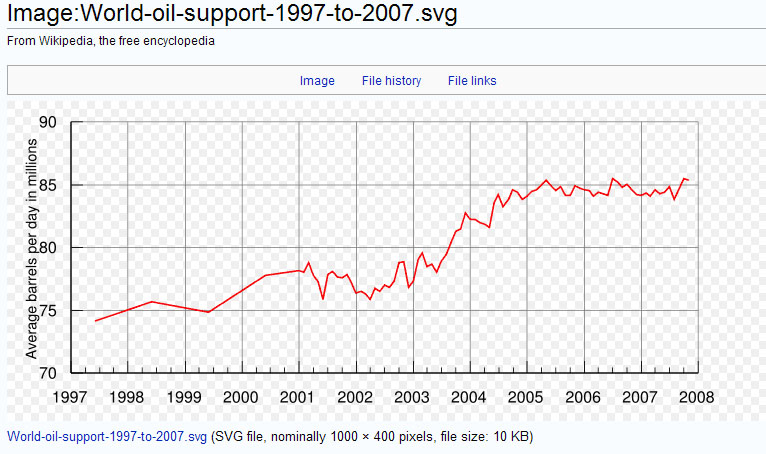
If we take the example of oil, in 1997 output was around 75 million bpd, and output had only climbed to about 85 million bpd in 2007 (a chart here shows the output - not a good source but the chart is usefully clear and conforms to charts from better sources). What we can see from 1997-2007 is an approximate doubling of the labour force, and only a tiny increase in the output of another key component of economic activity.

This quite literally means that the availability of oil per worker has seen a significant decline. In such a situation, there must be a consequence. If a worker in country A increases their utilisation of oil, then a worker in country B will have less oil available.

It should be noted here that worker in this context is narrowly defined as labour with access to capital, technology and markets, such that the doubling of the labour supply refers to the full entry of, for example, China and India into the world economy. The result of competition for finite resources means that we have entered what I term a period of 'hyper-competition'.

The reason why I am returning to this theme is the following news article from the Times:

The desolate, sun-baked deserts of southwestern Bolivia are poised to become the energy battleground of the 21st century, with China and Japan staking early and aggressive claims in the great lithium land-grab.

Japan, observers say, may have won the first round, but, with its mainstream resource ambitions thwarted on the Rio Tinto deal, China could redouble its efforts to gain a foothold in the salt flats of South America and the all-important technology metals.

And also, from the same paper yesterday, we have another related story:

CHINA is stepping up its race to secure access to global oil reserves with an audacious £4.8 billion bid for Addax Petroleum, a London-listed group with fields in Iraqi Kurdistan and Nigeria.

Sinopec, the Chinese state oil group, is understood to have tabled the indicative offer last week, trumping an earlier bid by the Korean National Oil Corporation.

Addax, which has one of only two operational fields in Kurdistan, has seen interest from would-be buyers increase with the completion of an oil-export pipeline from the region.

Sinopec’s approach is further evidence of China’s determination to use its cash reserves to seize control of the raw materials it needs to sustain its rapid economic growth.

What we are now seeing might be described both figuratively and literally as a huge 'land grab'by China. It is figurative in the broad sense that China is using its massive accumulation of wealth to shop for commodities and commodity companies, and literal in the sense that China is now seeking massive deals on the lease of land for agriculture, and is by far the largest player in a new wave of land lease deals (from the Economist):

It is not just Gulf states that are buying up farms. China secured the right to grow palm oil for biofuel on 2.8m hectares of Congo, which would be the world’s largest palm-oil plantation. It is negotiating to grow biofuels on 2m hectares in Zambia, a country where Chinese farms are said to produce a quarter of the eggs sold in the capital, Lusaka. According to one estimate, 1m Chinese farm labourers will be working in Africa this year, a number one African leader called “catastrophic”.

Returning to my recent article in Huliq, it is possible to see that the great game is now afoot, and that game is one in which the most competitive economies will win:

What we are seeing is a competition for the available supply of resources, and it is quite literally a zero sum game [erroneously written as gain in the original]. In such circumstances, the resources will flow to the labour that utilises the resource in the most cost effective way, and where there is the commensurately high return on capital. In other words, where resources are finite, where there is an increase in labour per unit of commodity, then there is a situation of hyper-competition.

The shape of what we are witnessing is slightly different to the way that I envisaged the competion would play out (at least when I first contemplated the way it would play out). My original vision was that it would be the competitive state of economies that would determine where resources would be allocated. Instead of this, the situation is one in which the countries with the greater financial resources are seeking to lock in natural resources through financial fire power.

This approach, in particular the growing activity of China, chimes with two other themes that have emerged in the blog. The first is the ambition of China to replace the $US with the RMB, and the second in the diversification of China's reserves away from $US assets into commodities. In a speculative article on how China might ditch the $US, I wrote the following:

As they move out of $US they would likely buy as many precious metals as possible without driving the price too high, as well as buying into emerging market, European and Japanese bonds. In doing so, they will be taking risks but with the benefit that they will be positioning the RMB as the next reserve currency. Furthermore, it is no secret that China has been trying to buy into various commodity companies (or natural resource companies), such as the ongoing saga of the Chinalco purchase of Rio Tinto or their wider expansion of investments in this sector.

I have been tracking the emergence of the RMB as a world currency over many posts. A strategy of locking more and more resources into Chinese hands would support such a strategy, with potential to influence a move to pricing of commodities in RMB. It is apparent that China is stepping up their determination and will to secure ever more sources of resource.

I have described this as a 'great game', but perhaps game is not the right word. When countries start to compete for resources in this way, one of the outcomes might be climbing tensions between the players. As yet, those tensions are not too heated, but there is worrying potential for this to be the future direction. There are indications that China sees this potential in their development of a 'blue water' navy (e.g. see here), which will allow them to project their power more broadly.

At the heart of the problem is that the massive increase in supply of labour has indeed created a zero sum game. As long as there is potential for shortages of key commodities, the world will remain in a situation of hyper-competition. The worrying part of all of the current activity is that the nature of the competition is perhaps fiercer than I imagined.

Note 1:

I have commented at the end of my recent article on the bond smuggling in Italy. Having rooted around on the subject, I came accross an article on ABC news which reports a massive forgery operation in US bonds, dated February of this year. The forgery includes the large denominations found in the hands of the smugglers. I found the article in a comment (sorry, I forget where), and it appears from the article that the bonds are likely forged. Lemming asks how this squares with the smugglers being Japanese, as the forgery operation is in the Philippines. At this stage, I am not sure.

However, as I emphasised in the article, this was all a little too 'James Bond'. As such, if a rational explanation emerges, I go with that. In this case, there is the underlying idiocy that anyone might have thought that they could pass off such large denominations as genuine. I forget who now, but I think one commentator on the blog pointed to the idea that we should never underestimate stupidity. It seems that idiocy is frighteningly common.....

The alternative is that the bonds are real, and that the forgery in the Philippines is just a coincidence. This coincidence is best measured against the coincidences of the recent Japanese unbridled support for the $US, and the location of the G8 in Italy. From my point of view, the forgery looks more promising....in particular now that it is no longer the North Koreans in the frame (as they would not have been likely to have undertaken such a poorly laid plan).

One puzzling aspect does remain, however. Why have the media not picked up on this story? It really is a great story, whatever the status of the bonds.....

Note 2: Lord Keynes - thanks for the link to Mises on the fixed money supply. Interesting reading....

Note 3: Lemming - you are right about China, but their industry is currently 'facing' towards supply to the West. As such, any change to domestic consumption will require possibly painful restructuring...

Wednesday, August 6, 2008

Why do Economists get it so Wrong?

Note: For some reason I am getting large numbers of people coming in directly to this page, which suggest that it has been a worthwhile post and is generating considerable interest. However, it is an unusual entry point to this blog, and the post assumes that you are one of the regular readers. As such, I would ask for your forbearance, as it assumes an element of knowledge of previous posts (having the effect of creating a strong interest in what is explained). As such I have not made it as easy as I might have. However, if you do stick with the post, it does stand alone, and may prove to be a revelation about the functioning of the today's economy, and why the UK and the West are in trouble . Alternatively, you may wish to start with the rather neat summary provided by a commentator at the end of the blog ( just scroll down) before returning to the main entry. You may also want to take a look at the post 'The Cigarette Lighter Problem' for a (perhaps unusual) context on the problem that the West faces, and this will help in clarifying why I am suggesting the UK (and the West) is in such deep trouble.

Original post starts here....

Today, I will make a rather belated (apologies for this) reply to a comment from a few days ago in response to my post 'Can the Economics of the Past be used to Predict the Future?' The comment was as follows:
'However, I still keep hearing 'experts' being quite complacent about the situation. On The World This Weekend at lunchtime Vicky Redwood, economist at Capital Economics, said that the reluctance of banks to lend to each other meant we might have a "technical recession" but hopefully not as bad as the early 1990s. (I asked around, and in my circle, nobody could remember the recession in the early 90s!). Another expert seemed to be suggesting that the problem is a "contagion" spreading through the economy, which makes it sound less than a fundamental problem.

As I understand it, both of these analyses are very shallow (only looking at the symptoms, not the causes), and these experts tacitly admitted that they are having difficulty making accurate forecasts. It made me wonder whether it ever occurs to them to step back and look at the 'bigger picture'. I suspect not.'
I did not see the interview, so I am unable to comment on the specifics of what was said. However, I think that this comment captures one of the problems of current economic thought. The world economy has changed significantly since the early 1990s. I have given an explanation for why this is the case in my post 'The Root of the Problem'. My argument is that there has been the development of a situation in which there is a massive over-supply of labour in the world economy, and that this makes the critical difference to the way in which the world economy is operating.

It may be worth reiterating how this provides a problem. Imagine that there are three factories that use commodity x, and the factories use a total of 100 workers (workers have a particular meaning outlined at the end). Each worker uses 1 unit of commodity per week in order to produce up to 100 units of product z. There is demand for 98 units of product z. There are 3 commodity companies who together can extract up to 105 units of the commodity per week. As such there is an oversupply of the commodity and a very small oversupply of labour, and this helps keep prices down.

Then something changes. It starts with one or two extra workers becoming available, and a new small factory is built to utilise their labour. Each of the new workers can supply half a unit of product z, but only adds a quarter of a unit of demand for product z. Initially, this is not a problem. They make very little impact upon the supply and demand, though their ability to produce more without greatly adding to demand holds down the price of product z.

However, because they can make the product z without demanding so much of product z in return means that this prevents the three original factories from raising their pay to their workers. As time goes on, the one or two extra workers start to increase in number, and as time goes by, they start becoming better at production so that they can produce just under 1 unit per week per unit of labour.

This is all fine, but suddenly there is a little too much of the product being made. The price of the product starts to drop, and with the drop demand overall increases, as more people can afford more of product z (including the workers in the new factory). The three original factories start to struggle, as they have too much labour. The price has fallen with the increase in supply, but their workers demand too much of product z in return for their labour, in comparison with the new factory. They realise that they must lay off workers, until such time as demand for product z increases to the point where prices will rise enough to give their labour what they demand.

As fast as the original companies lay off workers, new workers are appearing at the new factory. As each new worker is added, there is a new pressure on the price as the lost production capacity is replaced with labour that demands less of the product in return. Meanwhile the overall demand for the commodity is rising, along with demand for product z, as more workers can afford to buy it. The commodity extraction company notices that demand is rising and starts extracting more, but each week only add a fraction of a unit of the commodity to supply, such that supply in comparison to demand is slowly falling.

Furthermore, as it is apparent that a new factory offers the ability to produce the product more cheaply than the original factories, a trend of building ever more new small factories starts. Add to this that the new factories have improved on the amount of product z that each new factory produces per worker, and that the amount of the product z that the new workers are demanding for the labour is increasing slowly, and the situation sees a further escalation in demand.

The question here is; what happens next?

We have an ever increasing number of units of product z being produced as the original factories laying off of staff lags increases in supply (they are responding to the market signals), and we have an ever increasing supply of labour that wants comparatively less of product z per person, and we have an overall increase in supply of, and demand for, product z in comparison to the increase in supply of the commodity.

I was tempted to do this as a formula, but would rather let you use a heuristic/estimation approach (in part because I do not have the time, in part because it is clearer if you think about it).

We have several problems in this scenario. The first is that, as workers are laid off, there should be a decrease in demand for product z. In the real world this is not the case and the question is how this can be so? The other problem is that, where commodities are not keeping up with demand, what happens when commodity supply can no longer meet demand?

The second problem is relatively easy. With only so much increase in supply of the commodity, there will be a situation in which there will one day be excess capacity of labour in relation to the supply of the commodity, in particular in a situation where more and more workers are being added. This is the situation today. In this situation, only the factories that can manufacture product z with the least demand from the workers for product z will be able to to be supplied with the commodity. There is only so much of the commodity to go around, and only the most efficient factories will survive.

The other problem is that with only so much of the commodity, for a while, there will be an increase in the cost of the commodity, and therefore the price of product z will increase, thereby lowering demand, as the product becomes more expensive. In part this is offset by the increase in labour keeping demands for return for labour low, and the greater productivity of the new labour, but eventually the increase in the price of the commodity outstrips these factors.

Now, in a perfect economic world, what should have happened is that, as the new factory opened and commenced production, the workers in the original factories should have reduced their demand for so much of product z in return for their labour. Instead, they continued to demand the same amount of product z, and this led to their factories progressively shutting down. As this happened, there should have been a drop in the demand for product z, but this did not happen. Here is the mystery of the world economy. How is it that demand continued from the original factory workers? It does not make sense.

We are now in a position where one of the original factories has shut down completely, the remaining two are much smaller, and there are a mass of new factories. Available labour has now outstripped the capacity of the commodity. The price of product z has started to rise dramatically, and demand is therefore falling back. Sill the mystery remains of how it is that demand did not adjust with the closing of the original factory and the lay off of so many workers from the original factories.

It is here that we come to the 'economic miracle' of the last ten or so years. The new factories could produce product z without so much demand for workers for their labour of product z. This gave them a greater surplus per worker, and they then invested this surplus. Furthermore, as the commodity producers enjoyed ever greater demand, they made ever greater profit, and also invested this.

We now need to step away from this simplistic explanation, as it can not explain what happened next. This investment is the surplus generated from the emerging economies such as China, and the profits of the commodity producers. They invested this money into the governments of the West, and the Western consumers, thereby delaying the day when demand for product z would drop. It is only now that the supply of commodity is inadequate for the supply of available labour, that the problem has come to light. Demand should have fallen back a long time ago, but was propped up by bad investment of the surpluses that were created. Without a commensurate increase in supply of commodities, the growth could not continue. and without a lowering in demands from labour in the West, they were going to lose the competition for the allocation of the commodities.

We now have a mess. The west is in debt, prices are rising, demand is falling. The amount of commodity is only 120 units per week, but the number of workers is 140 and still growing. Someone somewhere is going to lose out. The amount of commodity per worker has fallen, and is falling further, despite the amount of commodities overall increasing. As such, the world as whole is richer. What has changed is that, whilst the world as whole is richer, the original workers must accept that the distribution of the commodities has changed.

When the original factories were in the West, they were using nearly all of the commodities, and were therefore the primary beneficiaries of the commodities. When the emerging economies entered the market, then the amount of commodities per worker was redistributed, such that some of that share was being transferred away from the West. Had commodities kept up with demand, then eventually (albeit with some painful adjustment along the way) everyone in the West could have remained wealthy, and the rest of the world become wealthier. However, in order for this to be the case, then there needed to be an increase in supply of commodities such that every single worker has the same amount of commodity per worker as we had in the beginning in the original scenario.

In other words, the only way that everyone could have won was to have exactly the same level of commodity extraction and production per worker as at the start of the change in the world economy.

The reason why economists have got it so wrong is that they have ignored the fundamental problem in the world economy. You can only grow the world economy if you have the raw materials to provide the means for growth. If not, then the raw materials will simply be redistributed. Redistribution means winners and losers.

It really is that simple.

Note: If anyone would like to do a scenario with all the numbers to illustrate the point, then this will be welcomed! Just add it as a comment, and I will publish it (it may also reveal some faults with my scenario?)

A note added to the post later: I mentioned that, as more labour enters the market, and commodity extraction increases, the world will be getting richer. I perhaps did not make one point clear enough. The overall wealth of the world on average has increased, but the likely outcome is that the wealth of the West will, on average, decrease. As such, whilst the world gets richer, a share of that wealth will be redistributed to the emerging economies such as China. In crude terms if we say that each of our Western consumers averaged a usage of 1 commodity unit per week, then the world must produce the same additional amount of that commodity for each new worker for everyone to reach the wealth of the West at the start. Where there is only 0.6 units of commodity per worker, then not everyone can be as rich as the West at the start. The question then arises as to how the new commodity per worker will be shared amongst different workers. More to the point, what happens when ever more labour is pouring into the market?

I should also clarify that a worker is a person with sufficient capital and infrastructure supporting their entry into the world labour market.

Another Note added 8 August: I just thought I would mention that I have been guilty of implying that the key differential between the emerging economies and the West is wages. It is not just wages, but all of the other 'benefits' that come with living in the West that are also part of the differential. These are structural problems. I address this issue in a rather unusual way in my post 'The Cigarette Lighter Problem'.