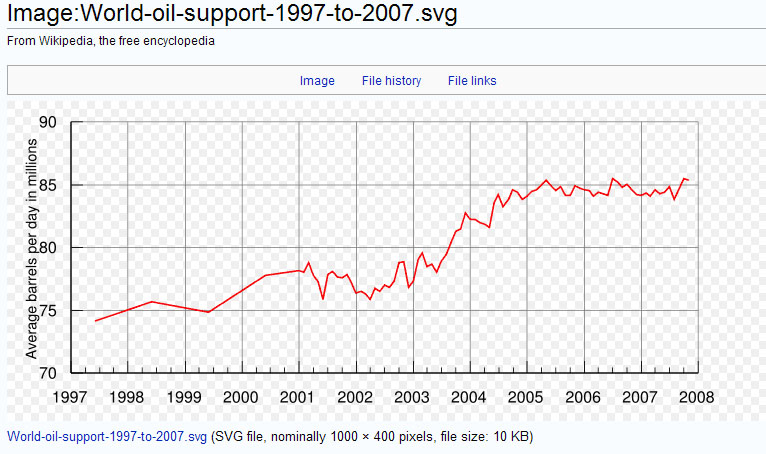
I've been watching the news over the last few days, and the world economy seems to be moving into very strange times. It appears that there is an increasing fear out there, and it also appears that the fear appears to be very generalised. By this I mean that people do not seem to have a clear handle on what is going on, and they just 'sense' that all is a long way from what it should be.
On the one hand there are the reassuring sounding stories and words of politicians who still talk of 'recession', and still talk of return to economic growth in a couple of years time. On the other hand there is the continual drip-drip of bad news, and the ever more outrageous attempts of Western governments to prop up their expiring economies. It seems that people can see that there is something inherently contradictory in all of this. If everything is going to be sunny in a couple of years, why the ever more dramatic action, and what can explain the extraordinary news of economies apparently falling to pieces before their eyes.
Regular readers of this blog will know the answers, and will know what is actually really going on. The principle is simple. If you double the world labour force in a period of ten years, something odd will certainly happen. I should emphasise here that by labour force, I mean workers supported by capital, access to technology and markets. This is what has changed with the emergence of economies such as China and India -the potential world labour force has doubled. Massive numbers of workers who were previously excluded from the global work force, have now been included.
The simple way to think of this is to imagine what would have happened to the world if the global supply of oil doubled in ten years due to a discovery of massive easily accessible reserves in Africa (whilst the global workforce size remained the same). The world would boom on cheap energy, but at the cost of the oil producer economies having to completely restructure. The world economy would dramatically alter, with the
pre-discovery oil producers taking the pain. In other words, if you drop a bucket of supply into the world economy, something is going to change, as long as all the other elements of the world economy remain broadly the same.
And here is the problem, that the world labour supply doubled, but the other elements of the world economy did not follow suit. So now, just as the doubling of oil would have rearranged elements of the world economy, so now the doubling of the labour supply is doing the same. The world economic balance is shifting to accommodate this massive oversupply of labour.
There is much more to be said for this, such as how the doubling of labour in emerging economies created the credit bubble. However I have dealt with this before. If you are new to the blog, you can read an introduction
here.
So why I am I outlining this? The reason is that nobody is talking about this, and I mean nobody. It is really becoming increasingly odd. Something profound is happening, and the only logical explanation for what is happening is just not appearing anywhere (except on this blog). I am less and less able to understand this. If you actually think about it, the explanations for the crisis only ever go as far as saying that there was a credit bubble, that this was caused by new financial instruments, but no discussion of the root sources of the expansion of credit. Without that explanation, there is something missing. I think this is at the heart of the unease. People are aware that something is very, very wrong, but they can not just identify what is happening.
It is for this reason that we see, for example, the possible sale of Volvo to a Chinese company as disturbing, but are not quite sure what it really means. It is why investors are pouring money into government bonds in the USA, despite
zero yields on the bonds. The world is turning upside down, economies are collapsing, and people are left clinging to the illusion that somehow, just somehow, the USA will somehow win through in the end. But that is how the Volvo sale connects. The giants of US industry struggling to survive, their home market is in free fall as the wealth of the world is moving rapidly to the East.
How does this square with the increasing difficulties of
China, or Japan? Quite simply, they are watching the markets that they supported with a wall of credit evaporate, and in the process they will see a huge destruction in their accumulation of capital from their export boom. Regular readers will know that, for example, I thought China
might pull through without
too much damage, but also that I expressed doubts. The reason for the doubts were that I always saw the linkages in the systems. However, whilst predicting this crisis, one of the points I should have considered is the amount of time that it would take for China to act and use its resources to ameliorate the effects of the downturn. With the benefit of 20/20 hindsight, it is obvious that China would not manage to deploy resources before the consequence of the economic collapse hit.
Now we come to the really curious part in all of this. Some time ago, one of the commentators on the blog (Lemming) asked why we could not just 'reset' the system. After all, around the world, compared with a year ago, there are the same factories making the same products, the same mines extracting the same commodities, the same workers serving hamburgers and so forth. If we could just write off all of the losses around the world, cancel all the debts, everyone would be fine. After all, there are now predictions that the world economy as a whole
will contract, so it might be argued that it is in the interests of everyone to 'reset' the world financial system.
I responded at the time of the original comment that this was fine in principle, as long as you were not one of those that stood to lose from the mass write-off of debt. However, there is a more fundamental problem. Capitalism is a rule based system, in which property is secured against arbitrary appropriation, and this engenders confidence. The degree to which the non-
arbitrary nature of the system is enforced is variable (e.g. Russia is problematic), but the system largely works.
However, for the sake of argument, lets imagine that the world financial system was reset with a zero debt balance and, for mysterious reasons, confidence would remain in the system. What would happen next?
It is at this point that we see the real problem that underlies the current crisis. The first thing that would happen, under any new reset system that incorporated free trade, is that the West would once again start importing a greater value of products from the East than it exported. Remembering that nothing else has changed in the structure of the economies, the balance of trade would remain as it has over recent years. The only way that everything could return to supposed normality of a year ago would be if the West once again started borrowing money to finance the deficits in trade. Regardless of the disappearance of the debt crisis, the underlying problem would remain. The West does not have the ability to finance the lifestyle to which it has become accustomed. In other words, the West can
only maintain the current standard of living on borrowed money. There is, quite simply, not enough real wealth creation.
I have used the thought experiment of a cancellation of debt to illustrate that the crisis never was, and is still not, about the financial systems. A healthy financial system can aid wealth creation, but the fundamental principle of wealth creation is that you need to produce products and services that can compete in the market place. When we look at the Western economies as a whole, they are failing in this basic task. It is possible to have a healthy financial
system and still be poor.
It is for this reason that I continually, and consistently, argued that the only solution to the economic crisis is a radical restructuring of the economies of the West. Amongst all of the measures being taken by governments, this is the one thing that is not under consideration. Until this competitive balance is addressed, nothing can rescue the West from inevitable decline. What we are witnessing is the painful and wholesale restructuring of the world economy to reflect the reality of the relative competitive position of the economies around the world.
It is for this reason that I have consistently opposed the bailouts, and all of the other measures that the governments are taking to 'fix' the problems. They do not fix the problems, but create new problems, or move the problem into the future. Quite simply, the virtual doubling of the world labour force, without a commensurate increase in the availability of the commodities necessary for growth, has created a hyper-competitive environment, and the West is burying its collective head in the sand in the face of this competition. The problem is that all of these 'fixes' are still rooted in the belief that the financial crisis caused the problems.
The fear that people feel is based upon a partly realised intuition that something has profoundly changed, and they just do not fully understand what it is. The trouble is that the change started about ten years ago, and only now is it becoming visible. The change was that the world became more competitive.
The change is that they are much poorer than they imagined.
Note 1: I am still working on the tax reform post, and will hopefully have it finished by the end of this week.
Note 2: 'Barking Mad' - I have already posted on the way in which the
BoE is going to try to hide their printing of money, including citing the Guido blog as the source. However, thanks for the link and comment.
Note 3:
Kecske has kindly left this
link, in which Frank Field discusses the possibility that the UK is bankrupt. The views of Mr. Field are a very close reflection of those that I have been expressing for some time. As I have mentioned, when the mainstream starts to ask questions about the viability of the UK economy, we know that things are reaching a crunch. Like myself, Mr. Field believes that printing money will be the method of default (because that it what printing money to pay debt actually means), rather than making a direct default. The most depressing part of the article is the comments that followed.....
Note 4: Lord
Sidcup has commented as follows:
you regularly state that too much regulation of international finance has (partly) caused this crisis rather than not enough regulation.
This statement baffles me, and rings untrue -- unlike everything else I have read of yours. I may well be wrong, but it seems like the product of 80's free-market ideology (again, unlike the rest of what I have read by you).
I listen to what is said by the the heads of banks, (nobel prize winning) economists, the hedge-fund managers, tv pundits, press jounalists and all the other 'experts' and I see varying degrees of delusion, wishful thinking, incompetence and dishonesty.
I would be grateful if you could clarify how it would be sane to trust any of these people to influence the global economy without stringent regulation.
I think that you have answered your own question here. The very people that you have such a poor opinion of are the very people that create the regulations. It was exactly these people that created the Basel Accords that encouraged the
CDOs and other murky financial practices. It was exactly these people who encouraged a false confidence in the financial system through the development of faulty capital adequacy rules. I could go on....
The trouble is that, whatever the regulation that is imposed, it will be these economists and 'experts' who design them. The trouble is that these people keep on getting it wrong. As such, I turn your question around as follows:
How would it be sane to trust these people to develop an effective form of regulation?
Note 5: I have had an anonymous poster offer a link on conspiracy theory as follows:
'I would like to recommend to you an outstanding Dutch researcher who I would even go so far as to say has probably produced the highest quality referenced conspiracy articles on the internet. As I’m sure all your readers will agree, I believe you’re an excellent writer and an extremely perceptive individual and as such I urge you to take a look at some of his work.
I highly recommend the fascinating article on the Pilgrims Society – its very long but extremely thorough:
http://www.isgp.eu/organisations/Pilgrims_Society02.htm'
Unlike many of the conspiracy theories, there is referencing and more detail than is the norm. I will leave it to your judgement as to whether you 'buy' the argument put forward.
Note 6: I have discussed the dangers of hyper-inflation resulting from printing money. A commentator on the blog has experience of this in Brazil and summarises his experience:
'You can ask any brazilian old enough what he or she prefers, between the 97-98 crisis or the 80s inflation, and he will def choose the first. In a hyperinflation scenario, you are living for the day, and thats enough to say how bad it is.'
There is nothing like some first hand experience to make a theoretical point come to life.....
Note 7: There were several other interesting comments, but I am afraid I am out of time on this post. I am afraid that, once again, the demands of the 'real world' are restricting my time....
Note 8: I have already had some very quick responses to this post, one of which appeared about 10 minutes after my posting the article! I just thought I would mention that one of the great pleasures in writing this blog is seeing the comments that are posted. The vast majority of the comments are intelligent and insightful, and often make very positive additions to the content of the blog.
For example, today's comment by Lemming is insightful, and I suggest you take a look at it. What Lemming has done has taken my post to the next step, and 'yes', he is right in a curious way that there is a 'reset' happening. It is just that the real reset does not have agreement, is being done through indirect means, and (of course) does not have the maintenance of confidence I proposed in my 'thought experiment'. Likewise, all of the other comments have something positive to add to the debate, and it is very rare that I hit the publish button without thinking that the commentator has something very useful to add. Overall, the quality of thought behind both the questions and comments is quite exceptionally good.
Note 9: More news of the possibility of quantitative easing - otherwise known as printing money to those who value straight talking - and the article can be found
here. The same article details the progressive fall of the £GB against the Euro. The idea that proposals to print money and a fall in the value of the £GB might connect does not appear in the article???
An interesting quote from the same article:
Peer Steinbrück, the German Finance Minister, described Britain’s switch from financial prudence to heavy borrowing as crass and breath-taking. In an interview withNewsweek magazine, he criticised the decision to cut VAT. “All this will do is raise Britain’s debt to a level that will take a whole generation to work off,” he said.
One of the interesting things about Germany is their resistance to the lure of artificial stimulus despite both domestic and international pressure (I hope this has not changed since this week's print edition of the economist). Angela Merkel, it appears, is one of the few leaders to retain sanity. However, Germany is in the fortunate position of still being a Western economy able to produce more than it consumes.
Meanwhile China is now actively stimulating its economy - but still manages a massive
$40 billion trade surplus for the last month. A rather good indicator of what I discussed earlier. However, despite the numbers here, there can be little doubt that China is going to suffer from a
continuing fast decline in exports. The key point here will not be who is hurt by the crisis, but relatively how much they will hurt.
I am being selective here, but compare and contrast the China news with the USA headlines, where the continuing saga of the bailout of their hapless domestic car industry drags to its painful conclusion. For example, one
report suggests that Chrysler is a basket case, and will never survive, but I personally have doubts about whether the other two might make it through (my guess is that just one might survive, as I have been tracking their progress to oblivion over several years in the Economist. My guess is that just Ford will be left standing in the end, but I profess to no special expertise in this area). The point to note is that, whilst China worries about a drop in exports, the US worries about the collapse of their industrial titans.
But just to rebalance....we should not forget the potential for social instability in China as the economy falls back....with all the potential for trouble that such unrest might cause. The dangers to the Chinese economy are very particular...
Note 10: I am perhaps a little unfair to pick on an individual. However, Anatole Kaletsky is now
saying the following:
There is nothing wrong with printing money - and plenty of it - in a period when prices are falling, property and stockmarket values are collapsing, banks are paralysed and the only assets that savers are willing to invest in are pieces of paper issued by the government.
Printing money and spending it on public works or on tax cuts, far from being profligate or imprudent in such conditions, is the only responsible thing for politicians to do. This is what Keynes demonstrated in 1936 in his General Theory of Employment, Interest and Money, which is one of the main reasons why there has not been a genuine depression in any capitalist economy since he published that revelatory book.
I quote this because this columnist has so consistently misunderstood the situation, and so consistently got it wrong, that I now look to his views to confirm that my own are likely to be correct. As long as he is suggesting the opposite to me, I feel that I am very likely on very solid ground. A little harsh, but.....