Showing posts with label Collapse. Show all posts

Wednesday, May 6, 2009

The US Economy: A Brief Review

With so much going on in the world at this moment in time, it is difficult to pick a particular subject about which to write. Having reviewed the state of China many times, I thought it might be time for an overview of the US.

A starting point is to consider the financial system, which raises the first point of interest. I have used the term the 'financial system', but what exactly that might be is a difficult problem of itself. In particular, the government and federal reserve appear to have identified the financial system as being comprised of several major banks, such as Bank of America and Citi. They do not seem to include in their considerations the many medium size banks and financial institutions that are also a large part of the system. As such, when statements are issued which effectively say that they must 'save the financial system', they are referring to the 'too big to fail' financial institutions rather than the whole financial system.

I will not detail the epic bailouts that have already occurred (of which there has already been enough coverage), suffice to say that they are indeed epic, and that the scale of the support is being obscured by the secrecy of the Federal Reserve (see here for total borrowings of depository institutions from the Federal Reserve - a bit shocking). Having done everything humanly possible to prop up the banks, including changing accounting rules to allow them to show illusionary profits, the state of the 'financial system' is still dire. News is leaking of the outcome of the so-called stress tests on the major institutions, and it is not looking very positive. Bank of America is reported as needing to raise an additional $34 billion of capital, and Wells Fargo $15 billion, and rumours suggest that 10 of the 19 banks tested need fresh capital. Whilst some of the other institutions are said to have passed the tests, analysts are pointing out that the tests are themselves flawed:
"The exams are too easy, the banks get to take them home with cheat sheets; and if they don't like their final grade, they can appeal for a better one," said Martin Weiss, president of Weiss Research Inc.
The same article points out that the pessimistic assumptions used by the Federal Reserve are simply not pessimistic enough, and this criticism has been echoed elsewhere. This raises the problem that the health of the banks is built upon assumptions for the state of the wider economy, and that mainstream economists have pretty well consistently underestimated the scale of the economic problems.

Perhaps the most important point to take from the stress tests is that, even with the gargantuan support offered by both the government in the US and the Federal Reserve, the 'financial system' still appears to be on the verge of insolvency. The IMF has suggested that the financial system may still need up to an additional $US 500 billion in order to achieve solvency, a figure which appears to suggest that the stress tests are really not stressful enough. Furthermore, the IMF estimates that losses in US banks might reach $US 2.7 trillion, a figure that is simply beyond comprehension. An even greater figure comes from Nouriel Roubini, as well as a damning evaluation of the banks, as follows:

This would be good news if it were credible. But the International Monetary Fund has just released a study of estimated losses on U.S. loans and securities. It was very bleak -- $2.7 trillion, double the estimated losses of six months ago. Our estimates at RGE Monitor are even higher, at $3.6 trillion, implying that the financial system is currently near insolvency in the aggregate. With the U.S. banks and broker-dealers accounting for more than half these losses there is a huge disconnect between these estimated losses and the regulators' conclusions.

The hope was that the stress tests would be the start of a process that would lead to a cleansing of the financial system. But using a market-based scenario in the stress tests would have given worse results than the adverse scenario chosen by the regulators. For example, the first quarter's unemployment rate of 8.1% is higher than the regulators' "worst case" scenario of 7.9% for this same period. At the rate of job losses in the U.S. today, we will surpass a 10.3% unemployment rate this year -- the stress test's worst possible scenario for 2010.

The stress tests' conclusions are too optimistic about the banks' absolute health, although their relative assessment is more precise, because consistent valuation methods were used. Still, with Thursday's announcement of the results, it shouldn't be a surprise when the usual suspects emerge. We fear that we are back to bailout purgatory, for lack of a better term.

What this all amounts to is a process of smoke and mirrors. In essence, the tests are set up to allow as many banks to pass as possible, and for those that do not pass to need a minimal additional capital infusion. Despite all the bailout money from the TARP, and the massive support of the federal reserve, the changes in accounting rules and so forth...the 'financial system' is still largely insolvent.

There are some suspicions that the Federal Reserve is simply too close to the major financial institutions, and that the ongoing support for zombie banks is a result of a that closeness rather than a wider concern for the health of the economy. In light of the actions of the Fed, it is difficult to dismiss such assertions, raising the question of whether there is a corrupted 'inner circle'. Alternatively, it is quite possible that the Fed really does believe that this is necessary for the wider economy. The problem arises that the endless bailouts make no real sense.

In particular, the situation that now exists is that the bank insolvency is being rescued at a (future) cost to the wider economy. One way or another, the socialised losses of the banks will be paid for by individuals or companies. If we actually think about what the financial system is for, this makes absolutely no sense whatsoever. The purpose of the financial system is surely to provide credit for businesses and consumers through the distribution of savings of other businesses and consumers, and to safeguard their savings and investments. It is not entirely clear how the (indirect) provision of credit to insolvent banks by business and consumers makes any sense. Instead of safeguarding and redistributing savings, the banks are (for want of a better expression) burning the (future) savings and money of consumers and businesses.

The fundamental problem that perhaps allows this, is the indirect and future nature of the policy. For example, if the cost of the bailouts were hypothecated and payable immediately, then how far would the policy have gone?

As I have often emphasised in this blog, any borrowing now represents a future contraction in the economy. If government borrows X to spend on Y today, then either the government, businesses or consumers will have X (+interest) less to spend tomorrow. The standard response is that (at some future point) growth in the economy will help to pay for the borrowing now. This raises the question of when the growth will arrive, and from what source/s?

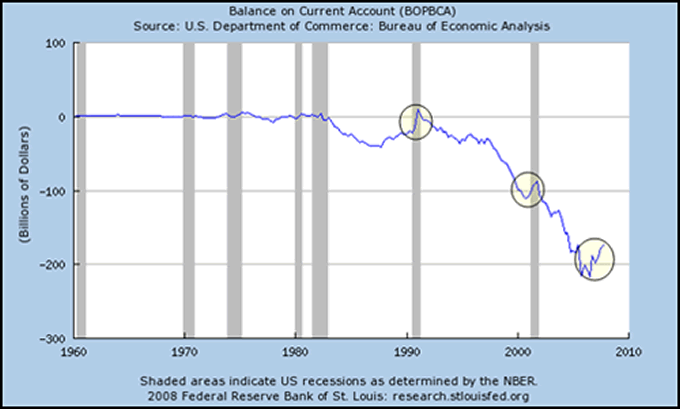
I recently read a report (sorry, in this case I forget where) that painted a sunny and optimistic outlook for sources of growth from emergent technologies. There can be little doubt that there is significant potential in such growth, but a larger question is whether such growth can reverse the ongoing contraction, and provide broad enough growth to replace the debt based economy. In particular, there is still an ongoing deficit in the balance of trade of goods and services. If you doubt the severity of the situation, you may wish to see the broader current account balance for the US here.

Whilst the deficits in the current account and trade are narrowing, this reflects that the US consumer is reigning in his/her spending, and such a contraction is therefore inevitable. The big question is as to whether this will eventually become a surplus, which is necessary if the US is to start repaying debt. In other words, the US needs to climb the mountain from deficits to surplus, before it can even start to repay debt. In light of the ongoing deficits for such a long period, this is a very tall proposition.

Meanwhile, the pile of consumer credit (i.e. a foregoing of future consumer spending) that is outstanding is quite monstrous, as can be seen in a chart here which shows $US 2500 billion outstanding (I use the Federal Reserve of St. Louis for much of the data in the post), and a chart here showing a rise in personal bankruptcy (albeit from a low base). Meanwhile, the savings rate is climbing from negative territory towards 5%, as individuals have realised that rainy days do indeed come about. The consumer is saving instead of spending, which is healthy in the long term, but means an ongoing contraction in the service economy.

As for a big driver of the credit bubble, the housing market, it continues its relentless decline, albeit that the rate of decline has slowed somewhat. At the same time there are reports of increases in consumer confidence, which are puzzling in light of the record contraction in consumer credit and the ongoing climbs in unemployment exceeding half a million a month (curiously the brief slow down in the pace of unemployment is being seen as a positive sign of recovery). Also, where might the consumer spending come from, if savings are increasing and credit contracting?

For business, manufacturing indexes have been in freefall, corporate tax growth is sharply negative (sorry for the idea of negative growth). Meanwhile investment is down sharply, as can be seen in this report:
Business investment contracted by a record 37.9 per cent, as firms scrapped expansion plans and axed jobs, pulling down overall output. GDP was also hit by a record $103.7bn (£70.2bn) reduction in inventories, or stockpiles of unsold goods – and while that accounted for 2.8 percentage points of the decline, it was hailed as good news by many economists.
I was hoping to provide statistics on bankruptcy, but could only find figures for 2008, which show growth in bankruptcy, albeit from a low baseline. However, there is no doubt that one of the key sectors in the US economy is in deep trouble, and that is the automotive industry. Whilst the government is keeping the industry on life support, it does not bode well for the wider state of the economy.

Bernanke is proposing that as inventories are restored, there will be some kind of recovery in the coming months. Whilst an undershoot on inventory sizes might lead to a brief upswing, it is difficult to see where renewed demand will actually come from, or at least demand that will possibly start to match pre-crisis levels. As for an underlying indicator of business health and confidence, commercial real estate is expected to be the next phase of the melt-down:
Schonberger: What's your outlook for the commercial real estate market?

Kemper: I think commercial real estate has yet to play out in the banking system.

I think that we've played out subprime largely, but I think that the same practices and the same players extended lost credit into the commercial real estate space in the past five years or so, and I think those losses are yet to be realized in the system.

Just as for consumers and businesses, the government has long been on a borrowing binge, with total debt now exceeding $US 11,000,000 million and the curve is (of course) rising rapidly. The Congressional Budget Office is predicting a further growth in debt of about $2 trillion in 2009, busting through the congressional debt ceiling of $US 12 trillion. The scale of the borrowing is simply astounding, and the debt is growing at a time of considerable economic contraction, and just as the baby boomer generation is set to retire. Quite simply, it is difficult to see how such levels of debt can be justified.

The nature of the government / Obama $US 787 billion bailout plan for the economy is such that it has been widely criticised for being highly political, and including various pet projects and so called 'pork barrel'. A typical criticism can be found here and another here:
"The stimulus bill was supposed to be about jobs, jobs and jobs, and it turned into spending, spending and more spending," Boehner said. "And then we've got this budget. ... And the fact is, we've got trillion-dollar deficits in his budget proposal for as far as the eye can see."
The criticism of the bailout appears to divide into two broad camps; those who say it is not enough and is directed into the wrong projects which will also take to long to enact, and those who just consider it wasteful and a burden on future generations. Perhaps the most worrying aspect of the bailout and growth in spending is the massive declines in income for the federal government, which can be seen on a chart here.

There is a more fundamental problem in the government attempts to spend its way out of trouble. Even if Keynesian economic policy is accepted (which is not the case in this blog), the increases in government spending would be difficult to square with Keynesian policy. One of the principles of the policy is to save during the 'good times' and spend during the 'bad times'. As can be seen on the earlier chart on government spending, the government had massively increased spending even before the economic crisis hit. There was also the equivalent of a stimulus in the form of the massive credit bubble that formed, such that the economy was subject to two artificial stimuli before the crisis hit. How spending on top of a credit bubble, and government debt binge might be justified is completely baffling.

In essence, what the massive government spending is seeking to do is return the economy to a level of activity that was itself dependent on the credit bubble and excess government spending. In other words, all the stimuli are aimed at returning the US economy to a position which was of itself inherently unsustainable. Is this a Keynesian stimulus? I think it would be hard to describe it as such.

The real tragedy in all of this is that the Federal Reserve has also chosen to lend support for the economy through quantitative easing (printing money), with this from the FOMC:
To provide greater support to mortgage lending and housing markets, the Committee decided today to increase the size of the Federal Reserve’s balance sheet further by purchasing up to an additional $750 billion of agency mortgage-backed securities, bringing its total purchases of these securities to up to $1.25 trillion this year, and to increase its purchases of agency debt this year by up to $100 billion to a total of up to $200 billion. Moreover, to help improve conditions in private credit markets, the Committee decided to purchase up to $300 billion of longer-term Treasury securities over the next six months.
The Federal Reserve is now embarking on a great experiment in monetary policy, and pumping ever more $US into the world economy. A good way to get a grip on the massive increase in the monetary base that is taking place is to look at the chart here, which gives an excellent sense of the dramatic increases taking place.

An underlying principle of such a policy is that, as soon as the economy tends towards inflation, the expansion in the money supply will be reversed by selling the assets accumulated by the Federal Reserve, and thereby destroying the money. This all sounds fine in principle, but the US government is, for example, already selling huge amounts of treasuries. As such, the Federal Reserve will add to the flood of treasuries already entering the market as soon as it attempts to reverse the money printing policy. There are already rumblings about the extent of the issue of treasuries from China, as well as concerns that the printing of money will inflate away the value of the $US:

“A policy mistake made by some major central bank may bring inflation risks to the whole world,” China’s central bank said in the report today. “As more and more economies are adopting unconventional monetary policies, such as quantitative easing, major currencies’ devaluation risks may rise.”

Chinese Premier Wen Jiabao expressed concern in March that the dollar will weaken, eroding the value of China’s holdings of Treasuries, as the U.S. borrows unprecedented amounts to spend its way out of recession. China’s Treasury holdings climbed 52 percent in 2008 and stood at about $744 billion as of the end of February, according to U.S. government data.

We also have an article in the Financial Times, which suggests that the $US is set for a major fall if China finally loses faith in the currency:

US policy is pushing China towards developing an alternative financial system. For the past two decades its entry into the global economy rested on providing cheap labour to multinationals and pegging the renminbi to the dollar. The dollar peg allowed it to leverage the US financial system for its international needs, while domestic finance re-mained state-controlled to redistribute prosperity from the coast to the interior. This dual approach has worked well. China could have its cake and eat it. Of course, the global credit bubble was what allowed the approach to be effective; its inefficiency was masked by bubble-generated global demand.

China is aware it must become independent from the dollar at some point. Its recent decision to turn Shanghai into a financial centre by 2020 reflects its anxiety over relying on the dollar system. The US will not pay attention to something so distant. However, if global stagflation takes hold, as I expect it to, it will force China to accelerate reforms to float its currency and create a single, independent and market-based financial system. When that happens, the dollar will collapse.

The problem might be summarised as follows. The US government is borrowing gargantuan amounts of money at a time when the economy is in freefall, and at a time when the government had already racked up massive debts through spending too much. All the while that the government was racking up debts, consumers and businesses were doing the same. The result of this were massive imbalances in the economy which created an unsustainable boom, with continual current account and trade deficits. Essentially, much of the US economy has been supported by this massive accumulation of deficits.

However, as the consumer deficit spending evaporates with the crash in house prices, the US government and Federal Reserve are acting to reverse the loss of unsustainable consumer spending through massive expansion in money, and even greater fiscal deficits. They are making no serious attempts to reverse the deficits, and have no clear plan for how both the government and wider economy might move from deficit to surplus. The recent 'austerity' being proposed by the Obama administration is quite simply pathetic, and will do nothing for the credibility of fiscal policy:

The effort to turn attention to fiscal austerity follows a three-month period in which Obama signed a $787 billion economic stimulus package and a $410 billion spending bill to complete the 2009 budget. The stimulus package includes funding for flood prevention and wastewater treatment programs Obama now says should be eliminated.

His 1,374-page budget for 2010 includes more than $1.2 trillion in funds that must be appropriated by Congress, including big increases in health care, energy and education. The contrast between the proposed new spending and reductions produced derision from Republican critics.

"It's like taking a teaspoon of water out of a bathtub while you keep the spigot on at full speed, and the bathtub continues to fill up," said Sen. Judd Gregg, R-N.H., who Obama tried earlier this year to nominate as Commerce secretary.


For creditor nations such as China, it must increasingly look like the US is initiating the largest default in history - through the destruction of the value of the debts through inflation.

If we then look at US GDP to gain an overview over recent months, the figures are quite simply dire:

The U.S. economy contracted at a steeper-than-expected pace of 6.1 percent in the first quarter, weighed down by sharp declines in exports and business inventories, according to government data on Wednesday that showed the economy was still deep in recession. [nN28309952]

The figure was weaker than analysts' forecasts of a drop of a 4.9 percent rate, according to a Reuters poll, and it also meant output now has declined for three straight quarters for the first time since 1974-1975. U.S. stock futures trimmed gains but still pointed to a higher open. [ID:nN29390529].

It is also important to understand that GDP is a measure of activity in the economy. As such, the figure is itself misleading as an indicator of economic health. For example, borrowed money creates activity, and this is included in the figures. As such, the GDP fall is taking place despite massive increases in government borrowing, which will have increased activity within the economy.

At the moment it is not hard to find optimistic projections for an economic recovery from many in the mainstream media, as well as from government sources. However, if we look at each sector of the economy, the only possible brightspot is a slight upswing in inventories. The idea that the economy might cease contraction overall is very dubious, although the money printing and fiscal stimulus might give a brief appearance of improvement. The trouble with these activities is that they are endangering the value of the $US, through the massive expansion of debt and the potentially inflationary increase in the issuance of the $US.

I received considerable criticism across the web for my predicted collapse in the $US, in particular for getting the time frame wrong. However, as each week goes by, the strains on the $US just seem to increase. The economy is still in freefall; many banks are still insolvent (whatever the stress tests might suggest), unemployment is rising, saving is rising (less consumer spending), businesses are failing, the housing market is falling, businesses are failing, personal bankruptcy is climbing, government deficits are increasing, GDP is falling, manufacturing is declining, commercial real estate is expected to plunge, record amounts of money are being printed, and overseas creditors are becoming ever more cynical.

Overall, it does not paint a very pretty picture. Somehow, people are still managing to be positive and optimistic about the US economy. This is a bit of a puzzle.


Note 1: An interesting debate followed from the post of Lord Keynes. As ever, he offered a well considered contribution, and this was recognised by many of the commentators. As a personal note, I would like to thank him for his effort and contribution, not just for the post, but for his many comments on my own posts. I would also like to thank the many others who contribute comments, which make this blog a lively destination.

Note 2: A review of the US economy proved to be quite challenging. In some respects, there is just too much information. In such a situation there is the possibility of selective bias. As such, if you feel that you have information that contradicts what I have outlined, please feel free to link to the source. I have also, in some cases chosen sources for convenience, and this is simply a matter of the time that I can put in to each post. If you have better sources, again, please feel free to post links. One of the great aspects of the comments on the blog is that commentators often turn up both interesting sources, and some interesting points of view.

Note 3: I did think about waiting for the stress tests before publishing, but decided that the nature of the tests was such that their only importance was in their impact upon confidence. As such I published sooner rather than later.

Monday, March 2, 2009

China, Gold and the $US

In the current chaos in the world economy, with endless potential avenues of news to pursue, with ever more extraordinary actions by government, it is becoming increasingly difficult to pursue all of the points of interest that I am seeing. For example, I would like to dig around a little to find out exactly what the Fed is up to with quantitative easing (QE - Printing Money), and hope to cover this in the near future.

I decided that, for the moment, a greater priority would be to try to find out what China is buying with its amassed foreign currency reserves, as this is possibly the most important single factor at this moment in time in the future of the world economy. In particular, China has the potential to make or break the $US. In several posts I have speculated that China will seek to offload $US assets, and will divest as many as possible before markets take fright. China's main holding of $US is in treasuries, and any significant sale of treasuries from China (or possibly stopping purchase of treasuries) will see the $US fall dramatically - or even collapse.

I believe that the $US is looking extremely vulnerable at the moment, and it would not take much for a collapse in confidence. Of particular note is that Warren Buffet appears to have come to the same conclusion, with his discussion of treasuries (and therefore the $US) as a bubble. The recent collapse in the prices of stocks has seen a new surge into treasuries, as investors seek safety, so a prediction of a collapse in this market at this time might seem unusual. However, the action of frightened rabbits caught in the headlights of an oncoming truck might not be considered as an indication of what will happen when there is time for thought.

The steep falls in the stock market are simply another indication of the fundamental weakness in the US economy, and that weakness suggests that the $US must eventually fall. China meanwhile has a delicate balancing act if they are to exit the US treasury market. Any hint of a mass sell-off would lead to a collapse in the $US, and would destroy the value of a large swathe of their reserves.

Within this scenario there is a major question that needs to be answered. If China does start to dump US treasuries, where will they hold their reserves?

The two most obvious contenders are the Euro and the Yen, but both are problematic. With regards to the Euro, this is looking increasingly unstable, though with some potential to buy into the government bonds of countries like Germany. Japan, as ever, I find difficult to fathom, but the speed and depth of the collapse of their export machine does not encourage much confidence. If China does exit the US treasury market, it is not immediately obvious where they might want to put their money. I have had several readers of the blog ask me where they should put their money, and China is in the same position as those investors but on a different scale.

The key difference that arises from such scale is that China has the potential to massively impact upon any market with which it is involved. The sheer size of their reserves means that they can swing any market up or down according to their actions. Aside from this difference, which requires a circumspect approach from China, I would probably find myself having made the same recommendation that I made to individuals nearly a year ago. This was that gold was the best prospect and an asset that might survive the turmoil (though I offered many caveats to this advice, as I am not an investment advisor).

The position of China as a potential maker or breaker of a particular market means that China will act in a way that is as opaque as possible. Even a hint that it is planning to exit treasuries would possibly see a rout, and any hint of entering a market likely to see asset prices rise. However, it is possible to pull some pieces of news/information together, and try to work out what China might do.

This is no easy task as we have the mixed messages coming out of China. For example, back in February, we have the now famous statement from the Chinese authorities on US treasuries, expressed in the following colourful language:

Even at the elite level, the sense of frustration occasionally bubbles over. "We hate you guys," Luo Ping, a director-general at the China Banking Regulatory Commission (CBRC), complained last week on a visit to New York. "Once you start issuing $1-$2 trillion . . . we know the dollar is going to depreciate, so we hate you guys, but there is nothing much we can do."

The same article goes on to say:

As China's economy slows sharply, the debate on how to manage its reserves is intensifying. Some propose spending the money at home; others want more diversification of investments. But the consensus behind recycling foreign currency into US government securities is coming under attack.

Essentially, China has expressed awareness of the delicacy of the position of the $US, but has still suggested a commitment to $US assets. The US government is clearly nervous of the situation, as can be seen in Hilary Clinton's begging bowl mission to China, which took place with unseemly urgency. Whilst China is making reassuring noises, this does not necessarily indicate China's actual intentions. As I have mentioned in previous posts, it would be likely that, even if selling treasuries, China would still make reassuring noises to prop up the value whilst they were undertaking the sales.

In one respect, China has been relatively open. It has made it clear that it expects that the US will follow a sound monetary/fiscal policy, if it is to continue as a buyer of treasuries:
The U.S. “should make the Chinese feel confident that the value of the assets at least will not be eroded in a significant way,” Yu, who now heads the World Economics and Politics Institute at the Chinese Academy of Social Sciences, said in response to e-mailed questions yesterday from Beijing. He declined to elaborate on the assurances needed by China, the biggest foreign holder of U.S. government debt.
It is here that we encounter the current policy of the US government. We have now had the first Obama budget. This budget was notable for considerable rhetoric on responsibility by Obama, but was lacking in any credible plan on how to reduce the budget or current account deficits. The actual substance of the budget was a massive expansion in deficits, and the budget therefore simply adds a new driver to the massive increases in US indebtedness that has resulted from the various bailouts, stimuli (monetary and fiscal), and the other many drivers of ever mounting borrowing. In total, the current US policy might be summarised as an expansionary spending binge, with no clear plan on how to pay back the borrowing . This will hardly conform with Chinese expectations of protecting their investments, and the Chinese government will surely not be taken in by Obama's rhetoric.

As such, if the Chinese were not simply trying to influence US policy with idle threats, it seems unlikely that they will be willing to continue to support the US economy with further lending.

Note: I was just set to publish the post and came across yet another article saying that the bail out in the US is expanding yet again, with Bernanke proposing more money to 'save' the banking system. At what point will anyone think 'enough!' Whatever the severity of the problem, the answer just keeps coming back - just pump in more money, at whatever cost....

With regards to actual Chinese activity, it is apparent that Chinese treasury purchases were already slowing in January, with some analysts suggesting that the mix of assets held have been altered in preparation for a fast exit from treasuries:

The U.S. Treasury’s international capital statistics showed that in November, China’s net holdings of long-term U.S. Treasury securities fell by more than $9 billion. However, the country’s short-term holdings rose by $38.2 billion. Determining the motivation here is difficult — it could simply be that China followed the rest of the crowd in jumping headlong into the safest securities possible, or more worrisome factors could be at stake.

“When any creditor shortens the term structure of its holdings, the borrower should probably be cognizant of that, because the creditor is giving up yield to give itself the option of exiting quickly,” says Brad Setser, fellow at the Council on Foreign Relations. “That’s one way to interpret the shortening of the structure of China’s holdings.”

A you would expect, I have tried to get some hard figures on what China is actually doing at the moment with treasuries, but have been unable to find any sources of this information (links/comments welcome). As such, I am unable to provide any firm information on the actual situation, which is rather frustrating. The same can be said for the Chinese position on European and Japanese bonds. However, with regards to European bonds, it seems unlikely that China has been moving out of treasuries into European bonds, as there have been problems in the sales of bonds in many auctions in Europe, even including German bonds. Had China been shifting holdings into these markets in any significant way, then such outcomes would be unlikely.

On the other hand, it has become apparent that China has been dabbling in the US stock market, and has therefore seen significant losses with the plunge in US stocks:

Provisional figures from the US Treasury department showed that Beijing was holding $99.5bn of shares in June 2008, up from $29bn in 2007. Two years ago, China only held $4bn in US equities, preferring to concentrate on Treasury bills.

However, economists said the latest figures suggested that China may have bought as much as $150bn of equities worldwide, or 7pc of its vast foreign exchange reserves.

Brad Setser, an economist with the Council on Foreign Relations, a US think tank, said the State Administration of Foreign Exchange (SAFE), a branch of the Chinese central bank charged with looking after the foreign reserves, was responsible for the buying spree.

This outcome might signal a return to treasuries, but just as likely might be a warning to China about the risks inherent in remaining in the US. Either outcome is possible, but I believe that the latter outcome will certainly be a consideration in the thinking in China.

Finally, we come to gold, the other possible asset that China might consider as a safe haven for their reserves. As I dug around, it became apparent that China has been beefing up gold investments for quite a while, as well as having a booming gold mining industry. Overall Chinese demand for gold is now the second highest in the world, with tantalising hints (unsubstantiated - see original article) that China is actively beefing up official reserves as well. However, before we get too excited that China will dump treasuries for gold, one analyst points out the following:

What about gold? That one’s easy: it’s estimated that all the physical gold in the world that’s ever been produced amounts to roughly 140,000 tons (worth about $4.5 trillion dollars using $1,000 an ounce). About 75% of that is either in coins or jewelry… not available to China, or to any other government.

The new gold available each year is miniscule: about 2,600 tons (almost $83 billion dollars worth) of new gold is being mined and refined annually, increasing the total supply by 2% per year.

You can see that China’s problem - if it wants to invest in gold as a diversification strategy - is that there isn’t enough available for sale. 30,000 tons are held in various government central bank vaults. Privately held bullion amount to about 20,000 tons.

Any major purchase of gold on the open market - which is where China would have to buy it - would drive up its price. To put this in perspective: China buys enough U.S. treasuries in one month to pay for all the gold mined in a year everywhere in the world.

I mentioned at the start of the post that gold represented a good opportunity for China, but there are limits to how far China might take such a policy. The same might be said for other precious metals. However, it does seem quite likely that precious metals will play a larger part in China's overall mix of assets. This still leaves the central problem of what else China might move into, if it moved out (is moving out of?) of US treasuries? The same analyst who points out that China can not shift into gold, also argues more broadly that there are no credible alternatives to US treasuries.

However, the analyst makes a basic error in thinking that China would have to take an all or nothing approach. He does not consider that China might spread their reserves over a wide range of assets, and this is my best guess for the direction of China's policy. If they follow this strategy, and implement it with care, China has the potential to rapidly jump towards becoming the world's most powerful economy.

The first step is to manage the sale of US treasuries with the greatest of care, such that they gain as much value of the sales as possible before the $US collapses. As they move out of $US they would likely buy as many precious metals as possible without driving the price too high, as well as buying into emerging market, European and Japanese bonds. In doing so, they will be taking risks but with the benefit that they will be positioning the RMB as the next reserve currency. Furthermore, it is no secret that China has been trying to buy into various commodity companies (or natural resource companies), such as the ongoing saga of the Chinalco purchase of Rio Tinto or their wider expansion of investments in this sector.

When the markets finally do spook, and the $US falls, China would need to keep selling hard into the market until the $US reaches a planned point at which China will halt further sales. I have no idea where that halt might be against what, but would guess that at the very least (whether I am right or wrong about the overall picture) China will have made contingency plans. With such large holdings of $US and the abysmal state of the US economy, it is hard to imagine that there is not an exit strategy for China.

Assuming that I am correct (a big assumption) at this point the US and OECD economies will probably go into a state of crisis, with stock markets collapsing and a wider state of panic amongst governments. Whilst the OECD governments will (I guess) have contingency plans for such an eventuality, there will be nothing that can be done to halt the slide when it happens. It is quite possible that there will be plans in place to support the $US in the event of a slide, in both Europe and Japan. However, I do not think anything will halt the slide once it starts.

With the US in shock, China can then use the remaining holdings of $US to go on a shopping spree into the US. In particular, China can offer to enter the markets with an offer of salvation - but at the cost of unopposed access to purchase the companies that might provide a leap into the high added value industries with technology or specialist skills. They will not put it this way but, in a climate of economic panic, they will be in a position of calling the shots, as the only significant player able to halt the slide. As a result of the panic, they will be able to buy even good companies at fire sale prices. As such, they will be able to use whatever $US assets they still hold to take a major leap up into added value industries.

Inevitably, such a large fall/collapse in the $US will see the undermining of the status of the $US as a reserve currency. The Euro is now in a position of such instability that it will not have the potential to act as a replacement. The Japanese Yen might have some potential as a replacement, but the RMB will be better positioned as the strongest contender. In particular, the Japanese will likely act to rescue the $US during the crisis, but will fail to stem the tide, and undermine the credibility of/weaken the Yen in the process.

If China was to follow such a course, it would put itself in the position of being the major world economic power, or would do so at least in principle.

So far, so gloomy and so apocalyptic......Astute readers may realise that this is all very highly speculative, and misses the underlying flaw in the whole strategy.

The flaw is that, if China were to follow such a course, it would also risk self-destruction. I have discussed this problem in many previous posts. The problem for China is that it has built its economy to service Western economies through high levels of exports. As such, if there is an economic collapse in the US and Europe, China will also destroy the markets for its goods. In doing so, it will see a massive contraction in the export sector of its economy, with a commensurate explosion in unemployment. The Chinese government is almost certainly aware of the fact that their legitimacy rests upon economic growth and nationalism, and that any dramatic fall in the economy might cause significant social unrest, including the possibility of major revolt.

Whilst this might suggest that China must continue to support the $US, in order to keep their export machine turning, it is not clear that this provides a solution for China. It is becoming increasingly clear that, whatever China itself does, the US is rapidly sinking into a quagmire. Under such circumstances it looks increasingly likely that the US is in any case collapsing as an export market and that, even without any action on the part of China, the $US must eventually sink. Whilst China can continue to prop up the US economy in return for increasingly worthless bits of paper (in exchange for the labour of their population), the US economy must in all cases eventually see a considerable contraction.

China is therefore faced with a choice of an all or nothing approach - or letting the US rapidly decline whilst they pursue a futile policy of trying to prop up the unsupportable. In one case they have an opportunity to extract the maximum remaining value from their reserves, and in the other they will simply pour more of their resource into a black hole.

I must emphasise that this is all speculation, as I do not know what the Chinese are planning, and what they might do in the current situation. China being China, it is hard to ever discern what their actual plans might be, as they lack any form of transparency whatsoever. However, it does seem that they have some hard choices on the best way for them to deal with the economic crisis. Whatever they do, they risk social instability, and even the possibility of major social unrest. Whichever direction they take, they will be entering into a high stakes game, with the potential for chaos should they make the wrong choices.

In all of this speculation, I am also making an assumption. The assumption is that the current US policy must mean that the $US will eventually collapse. I simply do not believe that a massively indebted country with very little in the way of savings, a massive current account deficit, can get out of trouble through an explosion in new borrowing and massive increases in deficits. It might be argued that this is simplistic, but I make no apologies for taking such a straightforward approach. However, with every new bailout or stimulus, the economic situation of the US just seems to deteriorate further. I think that China will be observing this and will take note of the fact that nothing seems to work in stopping the US economy from collapsing.

I can imagine that, within the closed world of Chinese policy making, there will be some heated debates on the best course of action. If, and it is a big 'if', I am correct, then it appears that the world economy is on a knife edge. If China is debating the position of the $US, they will be aware of the risks in waiting compared with the risks of acting to preempt the slide. Whilst I admit to being speculative in much of the post, I can not believe that China is not discussing this subject and, if there is a discussion about the risks, there will certainly be contingency plans. The big question is - which way will they jump?

(alternative scenarios welcomed in the comments section)

Note 1: For regular readers, they will be aware that I have long been expressing my concern both at the policy of QE (Printing Money), and the opacity of the policy with which it is being undertaken. I have recently written to the Bank of England (BoE), requesting some details on the policy, and have encouraged readers to write to their MPs asking for more information (see note 2, I have copied a suggested letter).

My concern has been that the most radical policy ever undertaken by the BoE, with potential for profound effects on the UK economy, has seen no detail of how the policy will be undertaken, without even any discussion of how much money will be created. Furthermore, in the information provided, it is clear that there is no formal mechanism for reporting what is taking place.

The bottom line is this. At present there is absolutely nothing provided by the government or BoE to distinguish what is going on from what happened in Zimbabwe.

A short while ago I received a letter from a BoE Press Officer requesting a 'chat'. I have now had that 'chat'. The summary of the conversation is that no further detail on the policy will be provided until the publication of the letters between the Chancellor and the BoE which discuss the policy. Whilst the BoE press officer was inevitably polite, he cast no light upon the policy. A long conversation amounted to 'wait for the letters to be published'. The only point of substance was a suggestion of a possible means of reporting the QE activity, but this was not an official statement of intent.

The worrying part of this is that this means that the first we will know anything about the policy is when it is actually implemented. As such, we will be seeing one of the most radical economic policies ever undertaken implemented without any discussion of the details of the policy prior to implementation. The idea that a policy with such magnitude of potential consequence for the wider economy should be undertaken in circumstances of such opacity is quite extraordinary.

The BoE letters are apparently going to be published very shortly, so I will await the publication. If they fail to clearly answer the questions that I have asked, then I will continue to pursue this matter as far as I can, including putting as much pressure on the BoE as possible. Whilst this blog now has a large readership (which is gratifying) I would also urge you to write to your MP requesting greater transparency.

To date I have expressed the view that QE is a method of financing government operations through the printing press. I have argued that the UK government is aware that it will have problems raising the money to finance operations of the government. As you will have noted in the above post, raising money through bond sales is becoming increasingly difficult. It seems more than a coincidence that, at such a time, the printing presses are about to start running. The opacity of the policy just serves to confirm my worst fears.

As such, when I review the BoE letters when they are published, my aim will be to closely analyse exactly what they commit to, and whether they leave any 'wriggle room' for either the BoE or government on the issue of full disclosure of exactly what they are doing with the policy.

Quite simply, this policy has the potential to wreck the UK economy, and I have seen nothing to date, and heard nothing to date, that offers any reassurance.

Note 2:

You can find the email address for your local MP here (click on the map for your constituency).

This is is my suggested letter which you can copy and paste, or alternatively write your own version:

-------------------
I am writing as I have very increasing concerns over the recent Bank of England policy to implement quantitative easing. In particular, I am worried about the following:

  1. There is no policy document that clearly outlines how this policy will operate, what quantity of money will be created, what assets the money will be used to purchase, and what method will be used for the purchases.
  2. In addition to this Mervyn King has suggested that the method of reporting for Quantitative Easing will be through the MPC minutes. This is not the purpose of the MPC minutes, and there is no requirement for full disclosure of activity in such a method of reporting.
This is all very opaque.

I am very concerned at such opacity in consideration of the fact that the Bank of England will be using money creation to purchase gilts. In this situation the Bank of England will therefore be creating ('printing') money to purchase government debt. This might be seen as government operations being funded by printing money.

Under such circumstances, it would be reasonable to expect the Bank of England to offer a transparent and detailed discussion of the policy as a formal policy document, as well as a formal, full and transparent procedure for reporting their activity.

I would therefore be most grateful if you could, on my behalf, seek to clarify why this process is being undertaken in such an opaque manner, and clarify exactly what the policy will be. I would also be grateful if you could press for a proper method of reporting on the policy of quantitative easing.
------------

Additions, suggestions for improvement will be welcomed. Just leave a comment below.

Note 3:

I predicted a while ago that the £GB or $US would collapse within three months, and that after the collapse of one, the other would follow shortly after. I am still convinced of the extreme fragility of the economic situation for both countries, and still think that I may yet be right. I have not checked the exact date I made this prediction, but I think I still have about 2-3 weeks to run before I am wrong.

I have been wrong about the $US before, and hope that I am wrong again this time. However, it seems that others such as Warren Buffet are also expressing concerns about the sustainability of the $US (if treasuries go, the $US will follow). I still think it will need an external shock to kick the $US down, but am becoming less certain of this. If I am right about China (a big 'if') then it might be that China will precipitate the fall...

Note 4: An interesting reply to one reader's request to his/her MP on the subject of QE (I assume using my standard letter). I will quote it in full, as it is more than a little disturbing:
'Have sent a copy of the letter to my local MP (Labour, Scotland). His reply:
Thank you for your email and I do appreciate your concerns at the current economic crisis. I am quite unsure as to the alternative that you believe may help steer our financial institutions out of the current mess?!'
That an MP can send such a reply sends shivers down my spine. If we take even a modest interpretation, we are getting a response that says that this is a desperate gamble.....

Note 5: There have been lots of comments on my post on the underlying cause of the economic crisis. I have has a further request from Josiah Stamp's Ghost and Jonny for some kind of forum, and will try to look into this at some point in the future. I am not sure that there is sufficient critical mass of readers (yet) to support the forum, but probably not far off. However, finding the time is not easy...

ChasH makes an interesting point, suggesting that offshoring might mean that there will be continued decline in strong companies in the OECD. I think that, once the balance of labour costs adjusts, this process might come to a halt as the cost versus benefits will alter. However, we will see...

Some interesting points of view from Lord Keynes, which I would like to address at some stage, time allowing. Lord Keynes appears to the devil's advocate amongst the commentators, which is useful to have on the blog. It is good to have challenging views.

Also, thanks in general for some interesting and stimulating links, which I nearly always follow up (I do occasionally miss one or two). One stood out as I already think highly of the author, which is as follows:

http://www.niallferguson.com/site/FERG/Templates/ArticleItem.aspx?pageid=203

Niall Ferguson is very astute, though I do not agree with everything he proposes. I am currently awaiting the arrival of his recent book on the history of finance, which may be an interesting read. If it is as good as I think it might be, I will let you know....

Sorry, yet again a quick review on the comments. I have taken a part random sample on this occasion, and will try to continue to address as many comments/questions as possible. I hope I will be forgiven, but I have had to devote quite a bit of time to posts recently.

Note 6: It occurs to me that this post is very speculative. I hope that it is seen in this light, and other scenarios/views on what might happen next are welcomed, as well as any critiques of my scenario.

Tuesday, February 10, 2009

'Yes' the bankers bear responsibility, but now they are scapegoats..

Before getting on to the main subject, please accept my apologies for the lack of posts recently, but 'real life' sometimes has to take a priority. As I still have demands on my time, a quick post today, and one which is a commentary on news, rather than a particular theme.

Perhaps the most important point I would like to make follows from an article in the Telegraph in which the commentator was discussing a bleak picture for the world economy. He refers to the huge US borrowing needs that are emerging.
Where is the money to come from? China, the Pacific tigers and the commodity powers are no longer amassing foreign reserves ($7.6 trillion). Their exports have collapsed. Instead of buying a trillion dollars of extra bonds each year, they have become net sellers. In aggregate, they dumped $190bn over the last fifteen weeks.
For regular readers, they will remember that I proposed that China would have to start selling US assets to fund their own stimulus, and that in doing so they risked a collapse of the $US. I noted that the Chinese would have to strike a balance in the volume of sales of these assets, such that they pulled in as much value as possible before the whole market collapses, leaving them with piles of useless paper. It looks very much like they are following this course, and the question that therefore looms in my mind is to ask how long before all the other $US holders follow suit?

In the meantime, for those who are probably already spooked in the bond market, the sheer scale of the continuing growth in US government commitments must be rapidly eroding what little confidence there may be left in the $US. On the one hand, Obama's 'stimulus' package looks set to progress through government, and on the other hand there is the latest bailout announcements for the banking system in the US. With each month that passes, the numbers, the massive and horrendous scale of the commitments of the US government, are moving beyond belief.

For those who look at these numbers, they are still comparing these numbers with notional and shrinking measures of GDP. However, for overseas holders of the $US there will be an increasingly frightening question that will by now be crossing their minds. In order for the US to repay this borrowing, at some point they must sell more goods and services than they import, must have a positive current account balance. In order for these monstrous sums of money to be repaid, this means not only reversing a massive trade and current account deficit, but turning these massive deficits into massive surpluses. Quite simply, it is not going to be possible to achieve this if the US government continues the massive borrowing, and attempts to support their economy through ever more borrowing.

In all of the measures, there is not one single measure that addresses fundamental structural reform of the US economy. As such, the holders of $US assets are going to very worried indeed. For those of you who still doubt the potential for a complete $US collapse, I will refer you to a link here, in which it is revealed that there was an electronic run on the US banking system in September, revealed in a C-span broadcast:
At 2 minutes, 20 seconds into this C-Span video clip, Kanjorski reports on a "tremendous draw-down of money market accounts in the United States, to the tune of $550 billion dollars." According to Kanjorski, this electronic transfer occurred over the period of an hour or two
I suggest that watching this will correct any misconceptions that the $US and world economy is not currently in a position of extreme fragility. The really odd thing about this is that the media have not grabbed hold of it yet.

Overall, the process of the unravelling of the $US appears to be going very much as I expected/predicted. The continuing desperate attempts of the US government to support ever larger parts of their economy is just adding fuel to the fire.

Meanwhile, as this is all going on, the world and the media are increasingly distracted with what can only be described as a media circus. The particular circus I am referring to is the question of executive pay, which has served as a handy distraction in which huge numbers of commentators and politicians can indulge in self-righteousness. The reality of the situation is that, whilst the bankers played a part in this crisis, they were not alone, but aided and abetted by government, regulators, and central banks.

However, with their cap in hand for ever more bailout money, one of the prices that the bankers have to pay is to take the full measure of blame on their own shoulders. They are not in a position to point their fingers at the others who have been complicit in the mess that has been created. The price is that blame is doled out to them, and they must bend over and take the beating on behalf of all of those who are responsible. Perhaps one of the more moronic variants in the media can be found in the Telegraph, regarding the enquiry into the crisis. I recommend reading this, if only to illustrate how puerile the whole business has become.

These enquiries also serve a more immediate distraction, which is to shift focus away from why so much money is being poured into an insolvent banking system. This is a matter of importance, not the pay rates of the bankers who are benefiting from the bailout. Whilst their remuneration should be a matter of public concern when they are being bailed out, it is insignificant when compared with the actual bailout overall (over some of my recent posts, I have been building towards a further discussion of the bailouts, but have not yet had the time to address this).

I can not help but think that all of this talk of evil bankers is simply a distraction which serves the politicians by diverting our attention from what really matters, which is that all of their plans and schemes are doing nothing to reverse the current economic crisis, and are already leading to the ultimate collapse of the $US in the case of the US, and £GB in the case of the UK. It only serves to direct all the blame onto a group who are unable to defend themselves, and who are therefore convenient scapegoats.

I will re-emphasise that I am not saying that the bankers did not play a part in the crisis, that they should not be getting large salaries at taxpayers expense, but the way that all of the blame is being heaped upon them is pure scapegoating. This is not a trivial matter, as it means that the others that were responsible for creating the mess are the very same people who are supposed to be resolving the mess, and often with policy that just replicates the original problem in new forms - in other words, the government borrows more as a stand in for the fall in consumer borrowing.

Without the economists, politicians and central bankers taking their blame, they can continue in their positions in which they can continue to cause so much damage.....

Note 1: For those who might mention that Obama is a new pair of hands......take a look at his economic team and policy....

Note 2: A rushed post, so I am sorry that I can not respond to the many good comments on my last post. I will try to catch up....

Monday, October 20, 2008

Economic Crisis - The Eye of the Hurricane before the 'Service Economy' Collapses

It seems that we have now entered a period of relative calm, following the storm of the bailout. For a while, following the Bernanke promise of yet more support for the finance system, stock markets rallied, only to later wobble on bad economic news. This is now becoming a pattern, where governments take action, markets have a fit of optimism, then the real economy offers bad news and pulls sentiment back down. In short, governments are pouring liquidity, guarantees, and borrowed money for short term bounces in confidence, completely ignoring the possibility that the underlying economy is in deep trouble.

I have spoken about the fact that GDP measures have been inaccurately measuring economic growth previously. I think it may be time to return to this theme, and take a look at why there is no escaping the simple fact that the US and UK economies must contract by such a large amount. Below is a chart of UK GDP growth:


And additionally a chart for US and Canadian GDP Growth (it includes Canada because this was the first good chart I found):


So now we have one side of the equation. What of the increase in debt? First a chart for the UK and US as a percentage of disposable income:


And now a chart for the US of absolute debt (the UK would look a similar shape):


My apologies for the variable sources for these charts, but I hope you can get a feel for the situation from these (I am rushed so just did a Google image search - I usually use the ONS but do not have the time to find the section). I did have a very good chart for the UK which shows that there has been a close correlation in debt growth and GDP, but have been able to dig it out again. However, if you review these charts, you will see that there during the recent boom, there has been a massive growth in debt. Like any figures that correlate the charts do not prove causation of GDP growth, but causation becomes more likely if there is an explanatory mechanism that can be identified.

So how can the increase in debt translate into GDP growth. I have discussed the multiplier effect, and also illustrated examples in 'A Funny View of Wealth'. The principle is very easy, and I will use the example in 'A Funny View of Wealth', as follows:

If we go back to Mr. Smith in the restaurant, we can see that he has borrowed money to finance his restaurant visit. In doing so he has decreased his wealth in order to fulfil a short term need. This is, partly, what wealth is for, but this is Mr. Smith’s future wealth that he is spending. This borrowed money that Mr. Smith has spent in the restaurant will then recycle throughout the economy in many ways. The restaurant owner will be a little wealthier, and will then spend some of the money on buying goods and services, the restaurant staff likewise, and so on. Furthermore there will be suppliers to the restaurant who will also be beneficiaries of the spending of Mr. Smith, as his consumption of foods will mean that the stock will need to be replenished, and the process of cooking will require energy, and some of his money may contribute to decorators, maintenance people and so on through all of the restaurant support services. We can then see the same process with each of these support services spending their small share of Mr. Smith’s transfer of wealth in a host of different ways, each further helping to support another layer of businesses.

It is only when we look at lots of versions of Mr. Smith, all borrowing money, all of which dissipates through the economy in a myriad of ways, that we can see what a dramatic effect this has on the economy. Throughout the UK economy there are millions of people who, just like Mr. Smith, are reducing their future wealth daily through the borrowing of money. Each of these individuals supports a multitude of businesses through each of their purchases of goods and services. This massive dispersion of borrowed money is financing large numbers of businesses, and the transfer of their (future) wealth that occurs is apparent in what appears to be a booming economy.
The reason why I am returning to this theme is that I have, on several occasions mentioned that the way that GDP is measured is flawed. In the case of borrowing, it can either be an internal transfer of wealth from within a country, or it can be from outside of the country. Much of the borrowing in the US and UK has been funded from overseas. Each time a person goes into a restaurant, or buys something on credit, there is a transfer of wealth out of the country, and a foregoing of future wealth. I will return to 'A Funny View of Wealth' again:

What if the money that provides the loan has been borrowed from outside of the UK, and the UK bank is effectively the ‘distributor’? In this case the transfer of wealth from Mr. Smith will go to the restaurant, the UK bank and the foreign bank. In this case, there has been a real transfer of wealth from Mr. Smith in the UK to the overseas bank that provided the finance for the credit. There is therefore a transfer of real wealth to the country of the overseas bank.

It could be argued at this stage that the overseas lender only has a very small amount of the total transfer of the wealth, and that the majority of the wealth goes to the restaurant owner. This is largely correct. However, depending on the status of the individual and the type of loan, the final interest that is paid on the loan might actually be very high, and translate into a large sum of money over the period of the loan. Some of this interest is profit for the UK bank, and some of the interest is profit for the foreign bank. If we say Mr. Smith is an overstretched credit user, with a moderate credit history, and give him a £500 balance on this credit card, an 18% interest rate, and ongoing minimum payments of 5% of the balance, this £500 will cost Mr. Smith a shocking £214 over the life of the loan. This is not an atypical profile for a heavy credit card user with a moderate credit history, but better and worse examples can be created in any number of permutations. In this case a £50 meal will see a transfer in wealth of £21 to the banking system from the restaurant goer, a significant loss of wealth to the individual, and a significant transfer of wealth to both the UK bank and the overseas bank. Different profiles will produce different results, and the example given is just to give a sense of the potential scale of the transfers. In this case we might hazard a guess that Mr. Smith has just transferred as much as £8 of his wealth to another country, in order to pay for a £50 meal, a meal that might otherwise have seen no transfer of wealth outside of the UK.

This is a very expensive transaction for both Mr. Smith and UK Plc, and has a negative impact on the overall wealth of both.
Despite this, the example of Mr. Smith above will be seen in the UK GDP figures as economic growth. My purpose here is not to recycle the original essay (which I recommend reading if you have not done so).

I have also not covered government debt in the charts, as you will all be aware of the growth in debt over the last few years, and this also creates a multiplier effect once it enters the economy.

The key point here is that the GDP figures do not reflect the reality of real growth in the economy, but growth in debt. If you factor in the multiplier effect, then it is even possible that the underlying growth of the economy might even have been negative. This is why I am predicting that the economy will have to drop back at least 10 years in growth terms, but quite possibly a lot more. As I have pointed out several times, the world was a kinder place for the West 10 years ago with still relatively little competition from countries such as China.

I thought I would add this post because the symptoms are now apparently arising from the disappearance of the debt based multiplier effect. Whilst the economy has been sliding very fast towards collapse, the first signs of spinning out of control have appeared. One of the first elements to go when consumers tighten their belts is discretionary spending. This means meals out, leisure activities of all kinds, and taxis in particular might be seen as the 'canary in the mine'. The reason for taxis being of particular interest is they are a particularly vulnerable form of discretionary spending, as there are always alternatives (albeit less convenient) to their use. They are also widely used in the evening, and are therefore a good symptom in the slowdown in leisure spending, such as restaurants, bars and nightclubs. Whilst there has been plenty of 'bad news' on consumer confidence and spending, I was struck by an article in which sales of new London black cabs are described as 'tumbling'. Whilst mainstream economists look to other (often abstracted) barometers, I am always looking for these kind of signals, as taxis are such a good barometer of spending behaviour. This example only applies to the UK, but the UK and US are going through a parallel process, so it might also be suggestive of the US position in the crisis.

From here we come to the real point of this post, the destruction of the service economy. Other articles are also starting to tell the tale (though the black cab story is the best illustration). For example, in the headlines today, there are calls for a fund to help small business survive the bad times, and another commentary is highlighting the plight of small businesses. Small business is at the heart of the service economy, and these businesses will be the first to really feel the pain. We should also remember that many of these small businesses will show a time lag before they start to appear in the bankruptcy figures. Again, the black cab story suggests that the we are now at a point where the pain has really kicked in. It is sad to say, but many small businesspeople will now be facing the hard fact that they are in deep trouble. The sole traders, and other small business people, are probably already appearing in the unemployment numbers, but the drip of new claimants will very shortly become a deluge.

If we strip out the debt led growth of the last 10 years, then the scale of the coming carnage in the economy becomes painfully apparent. Quite simply, most of the economy has been supported on a life support of debt, and now that life support has been switched off, we can start to see what will happen next. As I have said, the black cabs are the canary in the mine and we can now expect bankruptcy figures to soar.

Meanwhile, in the US, reportedly they are pressing Fannie Mae and Freddie Mac to boost lending, in a desperate attempt to regain credit driven growth. The same will happen in the UK, and there are already, for example, reports that pressure and/or legislation will be put in place to slow down the mortgage repossession process. We can expect to see more and more of such measures in the coming months. However, all they will do (at best) is create further losses for the financial institutions, and in many cases that will mean losses for governments.

Meanwhile, as time progresses, the fiscal position of both the UK and US government will deteriorate very rapidly, as the full savagery of the crisis are unleashed in the service sector. I am taking the black cab story as the signal that a new phase is starting in the economic collapse. I predicted the state of the economy as it now stands, as an ever faster downward spiral. I recently identified that all of the elements of the collapse were in place. I think that we are now about to see an even more rapid acceleration. The unemployment figures are going to rise at an ever faster rate, along with a massive rise in government expenditure, and government receipts are about to fall through the floor.

As such, I am very sorry to say that we are moving on track for the first government credit crisis, which I predicted a couple of weeks ago (as coming within three months). I suspect that the UK will go first, as the position in the UK is far more acute, and the US will follow shortly after. At the moment, the pattern of disaster is starting to emerge into reality, just as it did for the bank failures. Just as when I predicted the bank failures, the failure of (at the very least) the UK government is now probably irreversible. There was a brief period during which they could have built a buffer of confidence for creditors with a tough program of reform, but I believe that the moment has passed and the course is set.

At this stage, you might consider that this a fairly extreme analysis from the news about purchases of new taxis. However, if you think about the behaviour of your friends and family in their use of taxis, you will see why this is such a stark warning. If the money is drying up in the taxi business to this degree, then the rest of the economy is very likely freezing very fast.

Note 1: I have had an intriguing post from a regular commentator, who posts under the name Lemming. Lemming had the following to say:
Are you absolutely sure that our creditors will be turning the taps off any time soon? Is China, in fact, happy to fund our lifestyles indefinitely so they can simply 'buy' the West in the long term? To me, that sounds like a perfectly rational explanation, and Western politicians who espouse globalisation would be more than happy to facilitate it, I imagine, even if they were unaware of exactly what they were signing up for.
I have to admit, this a fair point. If China keeps lending, they will gain formidable economic power in the long term. As such, it is a very real possibility, and I can not discount that this might be a reason for continued lending. However, as China slows down, they might need to start to redeem some of that lending in order to support their own economy through the crisis, and will want to use whatever resources for that purpose, restricting their ability to lend. In this situation, depending on what happens with the Chinese economy, they may not have the option of continued support for the West. Another commentator kindly posted the following link, and I will repost it here as it applies:

Note 2: Another poster has kindly posted a link here. It makes interesting reading, in particular the article of 1998, financial capitalism vs industrial capitalism. I recommend it to all readers.

Note 3: Jeremy commented as follows:
Darling's plan of bringing spending forwards is truly dreadful. I can only imagine that he thinks that it might boost the economy prior the the next election as a last ditch effort for labour to avoid complete wipeout. I suspect the chances of that are nearly as small as the grey nobbly organ situated between his ears. Either way, we can reasonably expect sterling to get trashed in the process and look forward to some serious inflationary pressure moving into 2009.
This was a prescient comment, as £sterling has been tanking. The curiosity is the $US is still acting as a 'safe haven'. How much longer? Not much longer, I believe, though perhaps it will take the default of a major rich world government to finally do it? Meanwhile, would you lend into anything demoninated in £sterling at the moment? I think others will have their doubts too - which means that demand for £sterling to lend back into the UK will probably fall back, creating a stronger downward spiral.

Note 4: LordSidCup has the following to add to some other interesting comments:
My point is; if the politicians and financial elites could use whatever means to get confidence high again, is it possible that after after a correction things could stay the roughly the same/ a lower level ) for many more years, if not indefinitely?

Also, there are all these interbank debts looming, Credit Swaps etc, why don't the most important banks get together and write them off? I assume that would be painful, but as its all abstract wealth created as debt, what would it matter?
For the first point, others widely share this idea, but confidence is not a magic force but has to be rooted in something. If every day brings news of an ever slowing economy, ever smaller government receipts, then how can a government maintain confidence. Without the fuel of debt, it is impossible that confidence can be maintained, as I have outlined here. This is why every attempt to pour money into the economy sees a subsequent later fall in confidence. Reality just keeps on intruding and governments just do not have the resource to bail out both the financial sector and the rest of the economy.

For the second, the Credit Default Swaps are guarantees against default. They are therefore an insurance policy that moves real damage in the economy to a different place. Whatever happens, somebody will make the loss, and it is just a question of who will suffer. Note added approx 1 hour after the post: MattinShanghai has commented below on this answer and has pointed out that I have blundered. One of the wonders of the online world is that, when we make an error, we are soon corrected. Apologies to LordSidCup, for an incorrect answer....I will rethink and hopefully, if I have enough time enough to get my facts straight, will reply again.

A note to my note, added a little later.....MattinShanghai is quite correct to say that there is no knowing the size of the market, due to the private nature of the transactions. However, the products are an insurance contract, according to a reference I quickly checked: 'The seller sells protection (buys risk) and generally receives a fee for this protection' ('Credit derivatives and Synthetic Structures', J Tavakoli, 2001, p5). A note of caution however, as this in derivatives terms is a little dated as a reference. Apparently they are called swaps to avoid regulation as an insurance, which I dug out from Wikipedia, as I could not find anything more substantive in the economics journals on why they are not classified as an insurance. However, they still appear to be an insurance, whatever the legal niceties that determines their name. I think Matt is referring to the fact that:

'Economically, a CDS buyer is tantamount to a short seller of the bond underlying the CDS. Whereas a person who owns a bond profits when its issuer is in a position to repay the bond, a short seller profits when, among other things, the bond goes into default. Importantly, CDS buyers do not have to own the bond or other debt instrument upon which a CDS contract is based. This means CDS buyers can "naked short" the debt of companies without restriction.' from here.

It is, as Matt said possible to buy an insurance against another person's house burning down. The point I think that Matt is making is that, in principle, it is possible for LordSidCup suggests to happen. This is I believe the comment Matt made about the fact that the counterparties being on the line for more than the value of the original debt - the ability to profit from debt default....

However, the complete abandonment of the CDS contracts would presumably hit some institutions harder than others. In the current situation, where the banks are so exposed to wider damage as a result of defaults, in principle I can not see why it would not be possible to write them off if they could see a common interest in their survival as a group. The trouble is that the institutions who stand to gain would have a very tough time being able to justify their giving up their positions. Such a position moves into game theory, and requires trust and cooperation from all parties to secure a common good - it is not a zero sum game. It would face problems of imperfect information, due to the private nature of the transactions. Who does hold what, and what is their exposure, or their potential for gain? I am probably doing injury to game theory here, but hope that the answer helps. Thank you Matt for your clarification, and thank you LordSidCup for what was a far more challenging question than I originally considered. I also think that there is more to the point being made by Matt, so any further clarification will be welcomed. In the meantime, time allowing I will look at this a little more, and may add a further note if I have anything more to add. I am not sure that I have yet got to the root of the question, or the operation of CDS contracts. Even as I am writing, I have found a helpful quote on the underlying principle of CDSs which I hope will help others (The Journal of Finance, Volume 60, Issue 5 (p 2255-2281)'An Empirical Analysis of the Dynamic Relationbetween Investment-Grade Bonds and CreditDefault Swaps'), & a good introduction to first principles.
'Single-name credit default swaps (CDS) account for around half of the credit
derivatives market. They are the most liquid of the several credit derivatives
currently traded and they form the basic building blocks for more complex
structured credit products.1 A single-name CDS is a contract that provides
protection against the risk of a credit event by a particular company or country.
The buyer of protection makes periodic payments to the protection seller until
the occurrence of a credit event or the maturity date of the contract, whichever
is first. If a credit event occurs, the buyer is compensated for the loss incurred
as a result of the credit event, which is equal to the difference between the par
value of the bond or loan and its market value after default.
2. CDSs provide a very easy way to trade credit risk. Many corporate bonds are
bought by investors who simply hold them to maturity (Alexander, Edwards,
and Ferri (1998)). Secondary market liquidity is therefore often poor, thereby
making the purchase of large amounts of credit risk in the secondary cash
market difficult and costly (Schultz (1998)). Shorting credit risk is even more
difficult in the cash market. The repurchase agreement (repo) market for risky
bonds is often illiquid, and even if a bond can be shorted on repo, the tenor of
the agreement is usually very short. Credit derivatives, especially CDS, allow
investors to short credit risk over a longer period of time at a known cost by
buying protection.'
Matt may well be right that they are another bomb about to go off. No doubt they will add to the damage, but I still think that they are more likely to just relocate it. Defaults may melt one institution's balance sheet, but will improve that of another (assuming that the institution can pay). It all depends on the how many times the same house has been insured by whom, and that is not clear. This returns to LordSidcups question - as the lack of knowledge is a source of fear and that threatens stability further. In writing off the credit default swaps, the system as a whole would benefit, and that would be big plus for all instituions. However, I was not previously aware of some aspects of these derivatives, and suspect my knowledge is still imperfect. I would like to look at this more closely, but that is it for time for the moment.

Origninal post continues below......

I'm afraid that is all I have time for today.

Note 5: Despite my assertion of having finished, it should be noted that the LIBOR has fallen, which will hearten those who supported the bank bailout. However, is this because the state owned banks are now lending again because it is required, or because they think it is wise to do so? I do not know the answer, but in any case, the bad news in the economy feeding into more losses will drag the rate back up, unless the government has very deep pockets indeed....

Note 6: Oil has now dropped into the $60-70 per barrel level, as I predicted would happen. However, much, much sooner than I expected. For once, the news is positive, as the drop in oil prices will be a major positive for the world economy - as long as OPEC does not spoil the party by cutting back on production.