Saturday, May 9, 2009

Lies, Lies, Lies

My aim in this blog has largely been to give my best and most rational perspective on the reality of the economic situation. I have tried (and I hope) mostly succeeded in avoiding emotive and partisan viewpoints, and have tried as far as possible to see the actions of politicians as misguided. Of late, that perspective has been slipping, for the UK, the US and also for Europe.

I think that the key turning point was the Darling budget, in which the forecasts were so optimistic as to be beyond any rational belief. The budget was built upon these forecasts, and I simply do not believe that either Darling or Brown might even begin to believe such willful nonsense. Under such circumstances, it looks very much like Brown and Darling are willing to risk severe damage to the UK economy in order to prop up their electoral chances.

There are even more worrying signs, and these are more of a broad concern which extends beyond the UK into the whole Western world. Regular readers will know that I do not buy the conspiracy theorists, or that there is a nascent New World Order. I am far more inclined to the view that incompetence and idiocy are greater drivers of events than hyper-intelligent Mr. Evils plotting world domination. Furthermore, many of the conspiracy theories are nothing more than anti-Semitic nonsense, and if you are regular reader you will have seen many examples where I have highlighted such nonsense.

As for the idea that the evil bankers might have engineered this mess as a route to world domination, it is simply a laughable and implausible joke. As the major banks teeter on the brink of insolvency, with only government between them and oblivion, any notion that this might be a conspiracy for world domination looks positively delusional.

Having said all of this, it is not to say that there is nothing wrong at all. There are some very worrying aspects to this financial crisis, and that includes the role of both the financial institutions and the governments of the Western world. I am still not clear, even at this stage, whether the actions of governments are a combination of misguided thinking and power corruption, or just plain power corruption. What I am ever more certain of is that there is an unholy alliance between the financial institutions, central banks and government. To call such an alliance a cabal, or other such names, would be to dignify a rag-tag of self-interest and 'clubbiness'. However, that economic policy has ceased to serve the electorate, and is increasingly serving the large financial institutions is increasingly clear.

I do accept that the initial bailouts of the financial system might have been a panicked reaction to an emerging crisis, in which the politicians might have groped for any solution to try to stave off disaster. In order to do so, they inevitably turned to the heads of the central banks for advice and guidance, and may not have realised that the central banks were far too cosy with the institutions which they were supposed to 'supervise'. As such, we can safely put the initial reactions to the economic crisis down to a misguided and panicked reaction, though this can not be certain.

A good perspective on the relationship between banks, government and central banks has been provided by a commentator. The former Chief Economist of the IMF, Simon Johnson, has written an excellent article entitled 'The Quiet Coup', and he also includes how academic economists have been seduced into the orbit of influence of the major financial institutions. He paints a picture of the to and fro between government and the banks, from academia to the banks. For example, he has this to say of the close world of banking and politics:
One channel of influence was, of course, the flow of individuals between Wall Street and Washington. Robert Rubin, once the co-chairman of Goldman Sachs, served in Washington as Treasury secretary under Clinton, and later became chairman of Citigroup’s executive committee. Henry Paulson, CEO of Goldman Sachs during the long boom, became Treasury secretary under George W.Bush. John Snow, Paulson’s predecessor, left to become chairman of Cerberus Capital Management, a large private-equity firm that also counts Dan Quayle among its executives. Alan Greenspan, after leaving the Federal Reserve, became a consultant to Pimco, perhaps the biggest player in international bond markets.
My intention is not to rework an article that expresses very well and very clearly the clubbiness of this world. I would suggest that you read the original article, which is long, but worth the read. Instead, what I would like to do is put this in some kind of context, to explain how the unholy alliance between the politicians, academia, the central banks and the financial giants is leading the West down a road to destruction.

In my last post on the state of the US economy I discussed the fact that there was something very, very wrong with the bailouts in principle. From the very first bailout, I have consistently opposed the actions. In particular, I pointed out in my earliest posts on the subject, that the first bailouts would be followed by further bailouts as the economy spiralled downwards. It was very clear from day one of the bailouts that the banks were in worse shape than anyone was admitting. At that early stage, I just thought that the politicians were misguided, that the central banks were misguided. It may indeed be true that this was the case, but I am not sure that we will know for certain. Perhaps they always knew that the situation was only going to get worse - much, much worse?

So what is the fundamental problem with the bailouts? Quite simply, as I pointed out in the early posts, the bailouts will, one way or another, be paid for by other businesses and ordinary tax payers. We were told, from those early days, that the financial system must be saved, or see the economy collapse. This is the justification for this unprecedented and gargantuan attempt to support these insolvent financial institutions.

Back in the early days, there was sufficient confusion and shock for this point of view to gain traction, and to allow for the bailouts to progress forwards. However, the scale and scope of the bailouts has continually been obscured, and what has never been widely apparent is just how much of the total economy is now directed towards saving these insolvent financial institutions. Quite simply, the entire Western economic system now appears to be pointed towards rescuing these insolvent institutions. It is, to say the least, the most shocking economic madness.

Another article, from the same magazine as the Simon Johnson article, details the astronomical figures for interventions by the Federal Reserve. A summary of these, as well as the bailouts from the government, can be found here. It is worth a long look. The author of the article has this to say:
Through a dozen programs introduced since the crisis began, the Fed will be on the hook for trillions of dollars in loans, bailouts, and asset purchases. The government expects to be repaid for most of these commitments, of course, with interest. But that’s the tricky part. Largely unencumbered by congressional meddling, the Fed has in most cases refused to reveal the beneficiaries of its largesse—or what assets they’ve used as collateral—lest panicky investors and depositors lose faith. As a result, outside the walls of the Eccles Building, almost no one knows how sound those loans really are.
In one very effective interactive graphic, the scale of the overall combined US government and Federal Reserve assistance becomes apparent. Again, spend some time on the chart. It is quite simply astounding.

If we then look at the UK, we see a similar pattern, but I have yet to see a source that pulls all of the costs together so neatly. From the Guardian, we have a graphic which shows the direct bailouts as £25 billion Northern Rock, £42 billion Bradford and Bingley, £37 billion HBOS/RBS/Lloyds, £22.5 billion more for RBS, and up to £10 billion for Lloyds. On top of this is the Credit Guarantee Scheme which is to:
make available new capital to UK banks and building societies to strengthen their resources, permitting them to restructure their finances, while maintaining their support for the real economy; and ensure that the banking system has the funds necessary to maintain lending in the medium term.
The scheme provides up to £250 billion worth of guarantees (the page linked to says 'at least £200 billion), and the users of the scheme are dominated by the 'usual suspects' such as RBS, but also includes Tesco Finance. We then have the Asset protection scheme, at £525 billion, with (you guessed it) RBS already having £325 billion insured under a scheme to insure risky assets, described by Vince Cable as:
“fraud at the taxpayer’s expense” and that it was weighted heavily in favour of the banks, who were being invited to dump their worst assets on the Treasury.
To these bailouts we need to add the Special Liquidity Scheme, 'to allow banks to swap temporarily their high quality mortgage-backed and other securities for UK Treasury Bills', which adds up to another £185 billion lent by February of this year (the Bank of England claims that there is no risk in the scheme - but why was it then necessary?). Finally there is the Asset Purchase Facility (£50 billion at the outset), which has subsequently morphed into the £150 billion quantitative easing scheme.

All told, these facilities add up to a massive government/central bank response to the insolvent UK banks, with many of the facilities creating massive potential liabilities. We are looking at a total that amounts to around £1 trillion of support for the banking system.

In both the US and the UK, the scale of this activity has seen a massive growth in the balance sheets of central banks, and a huge increase in their potential liabilities, as well as huge expansions in government debt.

It is at this point that we need to pause, take a long breath, and actually consider what it is that the banking system is for. In the many bailouts and rescues, we simply hear that the financial system must be saved, but do not hear what it is supposed to actually do. The standard line being trotted out is that the banks must be saved to get credit moving again. The question here is why it is that the limited numbers of banks that have received most of the various support measures are so important, and that is the question of what financial services are actually there for.

It is when we ask this simple question, this blindingly obvious question, that we can see the level of the fraud that is being done to the taxpayers and the damage to the wider economy. The financial system is indeed important in the provision of credit, in particular it is important in the provision of mortgages, investment in business and so forth. The core function, the real function of financial institutions, is to take the savings from person A, and make the money available to person B, or company C. As part of that process, the expectation is that the bank will lend the money with a level of care which is appropriate to the level of risk expected by the saver.

Here we have the problem. That is it. That is the only function of a bank/banking system in a healthy and well balanced economy.

As long as there are banks able to undertake this role, then the banking system is operating. In no way is any individual bank necessary for the underlying function of the financial system. Banks are intermediaries which should be there for the investment of savings, and provided that banks are able to function in this way, then the system is operating.

I am sure that this point of view will inspire objections (I look forward to the comments), such as the idea that the failure of the 'too big to fail' banks would have seen major bank runs, and a period of financial chaos. I do not, and have not, disputed this. The inevitable result of the failure of, for example RBS, would have been lines of people at every major financial institution, and a systemic failure. There would also have been social disorder and a period of great stress. However, the pain would have been short and sharp, and far less costly to the wider economy. It would have cost, but the bill would have been so much less than that which is now accumulating.

But here is the problem. We are now in a situation where our economic future is now being poured into the bottomless pits of financial institutions that are still insolvent, and which are going to need ever more support on an ongoing basis. The insolvent banks are quite literally eating up our present and future wealth, and threatening the very integrity of the Western economic structure. It is turning an economic crisis that turned into a financial crisis, and now risks turning these crises into a economic crisis of a magnitude that will threaten everything that the Western world has represented.

These are strong and dramatic assertions. However, as I have watched this crisis unfold, I have at various stages seen opportunities to turn the situation around. At every point in the crisis I have seen ever deeper digging of the hole in which we find ourselves. I now think that we are reaching the stage where the nature of the bailouts, the nature of the eventual cost to the economy, are so great that the very faith in systems that have supported Western democracy might be undermined.

In particular, the amount of support for the banking system is a ticking time bomb, and a time bomb because, quite simply, those that are governing us are lying about the costs to ordinary people - the cost for their support, and the denial of the risks that they incur with each round of bailouts.

I have come to this conclusion over several months. I have watched as insolvent banks are allowed to declare profits when they are insolvent through accounting tricks - supported by governments and central banks. All we have to do is see the massive support that has been poured into the banking system to see that any notion of profits must be a lie, but governments, central banks, the media, and even academics are all supporting this lie.

More recently, we have seen the so called bank stress tests in the United States. As one analyst identified (sorry, I can not find the link), even under optimistic projections, there is a massive amount of losses coming the way of the banks. Apparently they only need $75 billion of new capital, even though this is nowhere near enough to cover such losses. As the analyst pointed out, for the stress tests to be set at the right level, this would mean that the banks are currently massively over-capitalised - a complete absurdity. A brief review of the news stories (e.g. here) showed that the banks were negotiating on the levels of capital that were required of them. How can this be justified?

Quite simply, we are being lied to in a systemic way. The banking system is still insolvent, and ever more support will be needed to hide this reality. This is support at a cost that is creating ever greater strains on the rest of the economy - and which will eventually sink the rest of the economy to a low that we can not imagine.

All built upon lies, lies, lies.

As if this were not all bad enough, we have what has become a subject of great interest to this blog - the weasel worded quantitative easing, or printing of money by central banks. As I have pointed out endlessly, this is one of the most outrageous policies that is being undertaken by the central banks, and can only end in ruin for the economic well being of the countries undertaking it. The explanations for the policy all follow a line that says that it is to ease credit in the marketplace, but the problem is that - once started - it seems to rapidly move into the purchase of government debt. Whilst there are technical explanations trotted out for this, it seems more than coincidence that the central banks undertaking this are those who are issuing huge mountains of government debt.

If you doubt this, take a look at the debate for the European Central Bank's move to the policy, and you will find that it is the southern countries of Europe and Ireland, countries in economic freefall, true bubble economies, that have pushed through the policy against opposition by Germany. Whilst government debt is not on the list for purchase yet, viewing the countries that pushed the policy it can only be a matter of time.

As if this is not bad enough, that central banks are indirectly monetising government debt, there are rumours that governments are now buying their own debt. This is still unsubstantiated, but this from Ambrose Evans-Pritchard:
Traders already whisper that some governments are buying their own debt through proxies at bond auctions to keep up illusions – not to be confused with transparent buying by central banks under quantitative easing. This cannot continue for long.
Quite frankly, I suspect that the rumours are true. When discussing QE, this was one of the themes, or scenarios, that I considered. If true, at some point the truth will eventually emerge, and the consequences can only be dire.

Once again, we have lies, lies, lies.

And then there are the economic forecasts. We have the infamous Darling budget, a work of fiction, a new sunny forecast from the Bank of England (but nevertheless a suggestion of continuing extension of quantitative easing??), Bernanke and his optimism for recovery in consumer spending and the housing market and for the banking system. I hope that I showed in my recent review of the US economy that, quite simply, there is no prospect for any imminent recovery - at best a brief uptick or an inflationary 'recovery'.

Lies, lies, lies.

Above all else, we can see the lies working their way through the stockmarkets. If ever there were a suckers rally this is it. From one blogger, we have lists of 'insiders' buying and selling, with insiders selling hard (see here, here and here). Quite simply, this rally is built on lies, as no recovery is in sight. No doubt, those that will be hurt in the rally will be the outsiders, or ordinary people.

And the truth? In the UK, there are bloggers like myself, and a small number of commentators who question what is going on. For example, there is Fraser Nelson at the Spectator who, whilst a partisan commentator, is highlighting the 'fishiness' of quantitative easing. There is Liam Halligan at the Telegraph, who highlights in his most recent article that the end of QE will create a problem of how to sell bonds into a saturated market. There are more, but overall there are far too few commentators who are confronting what is going on, and questioning the underlying lies.

In the US, the situation is slightly better. Although there are legitimate critiques of Austrian economics, at least they are highlighting the nature of the lies. The Mises institute is pouring forth a steady stream of articles highlighting the madness of what is going on, with Ron Paul pulling that critique into practical political action (such as his campaign for an audit of the Federal Reserve). On top of this, there are the maverick bloggers, and the influence of people like Peter Schiff.

Most alarming of all, the greatest and most listened to cynicism is coming out of China - who see the QE policies of Western governments for what they are - harbingers of inflation. How desparate is it when it takes a totalitarian state to ram the truth home?

This is why I am writing an unusually angry post. I am sick of the lies that issuing forth, and I am sick and tired of the way in which the insiders appear to win, regardless of the cost to the rest of the economy. I have watched in horror as these bailouts have chewed up the wealth of the Western economies, both present and future wealth. I have watched in horror as governments have issued ever more debt to support their profligacy and support insolvent banks. I have watched in horror as central banks have commenced monetising government debts, and likely engineering inflationary defaults whilst risking eventual hyper-inflation.

Above all, it really does appear that governments and central banks are willing to sacrifice ever greater swathes of the economy to rescue incompetent and insolvent financial institutions. The only explanation that fits the facts is the grubby clubbiness of the system. It is not the great New World Order conspiracy, but rather the conjunction of interests between well placed individuals. Each, in their own way, moving forwards for their own personal gain. It is not the activity of great conspirators, but rather the collective movement of little men, of people who can think only of their personal gains. Money, vanity, power.

And the cost....

.....for there surely will be a cost.

That the economy will be left in tatters, I have no doubt.

That will mean unemployment, insolvency and hardship for many. But the cost will go much deeper than this. When the situation resolves to its eventual conclusion, and the real hardship starts, then the questions will start. The first and largest question to be asked will be to determine where our wealth went. Where did all of our wealth go?

At that point, as the lies are shown for what they are, there is the risk of the greatest cost of all. The risk is that people will start to question the legitimacy even of our form of government. The risk is that democracy is now in the firing line.

In the UK, a scandal is unfolding, a petty and mean scandal over how MPs have cheated their expense system. The status of politicians is at an all time low. If we look to the US on the other hand, the situation looks more benign. Obama is receiving widespread approval from those that he leads. In the case of Obama, I can see only the motive of personal vanity - that he believes his own mythology of being a saviour. However, in painting himself as a saviour, he risks the anger of dissillusionment when disaster comes in place of salvation. That is a dangerous thing.

When people are angry, when they feel disillusioned, and when they feel cheated - as they surely have been - that is when the crazies gain traction. The promises of brave new worlds, of new beginnings, the pied piper tune of 'if you just follow me...' This is the risk. I have alluded to this risk in a few early posts, and it has been part of my drive in writing this blog. I think we are now close to a point where such a risk is becoming real.

The extent of the manipulation, the cheating, the lies is now extending beyond what might be accepted. I think that people will become very, very angry.

An unhappy post.....

Note 1: I hope that this post does not offend regular readers. I have paused on hitting the publish button on this occasion. However, I think that this is worth saying. I believe that now might be the time for anger, as a way of possibly forestalling a greater anger later. As I wrote this post, I kept in mind that one of the commentators on the blog, Steve Tierney, is a politician. I think that even those that disagree with Steve would accept that he is a sincere and decent person. As such, I have some optimism - that perhaps there is an opportunity for a more decent and honest politics. My underlying worry is that perhaps there are too few of such people.

Note 2: A big thanks for the links against my last post, which led me to some articles that helped me pull this post together. As ever, very good comments, and my apologies for my lack of replies (as this post took a while to put together).

Wednesday, May 6, 2009

The US Economy: A Brief Review

With so much going on in the world at this moment in time, it is difficult to pick a particular subject about which to write. Having reviewed the state of China many times, I thought it might be time for an overview of the US.

A starting point is to consider the financial system, which raises the first point of interest. I have used the term the 'financial system', but what exactly that might be is a difficult problem of itself. In particular, the government and federal reserve appear to have identified the financial system as being comprised of several major banks, such as Bank of America and Citi. They do not seem to include in their considerations the many medium size banks and financial institutions that are also a large part of the system. As such, when statements are issued which effectively say that they must 'save the financial system', they are referring to the 'too big to fail' financial institutions rather than the whole financial system.

I will not detail the epic bailouts that have already occurred (of which there has already been enough coverage), suffice to say that they are indeed epic, and that the scale of the support is being obscured by the secrecy of the Federal Reserve (see here for total borrowings of depository institutions from the Federal Reserve - a bit shocking). Having done everything humanly possible to prop up the banks, including changing accounting rules to allow them to show illusionary profits, the state of the 'financial system' is still dire. News is leaking of the outcome of the so-called stress tests on the major institutions, and it is not looking very positive. Bank of America is reported as needing to raise an additional $34 billion of capital, and Wells Fargo $15 billion, and rumours suggest that 10 of the 19 banks tested need fresh capital. Whilst some of the other institutions are said to have passed the tests, analysts are pointing out that the tests are themselves flawed:
"The exams are too easy, the banks get to take them home with cheat sheets; and if they don't like their final grade, they can appeal for a better one," said Martin Weiss, president of Weiss Research Inc.
The same article points out that the pessimistic assumptions used by the Federal Reserve are simply not pessimistic enough, and this criticism has been echoed elsewhere. This raises the problem that the health of the banks is built upon assumptions for the state of the wider economy, and that mainstream economists have pretty well consistently underestimated the scale of the economic problems.

Perhaps the most important point to take from the stress tests is that, even with the gargantuan support offered by both the government in the US and the Federal Reserve, the 'financial system' still appears to be on the verge of insolvency. The IMF has suggested that the financial system may still need up to an additional $US 500 billion in order to achieve solvency, a figure which appears to suggest that the stress tests are really not stressful enough. Furthermore, the IMF estimates that losses in US banks might reach $US 2.7 trillion, a figure that is simply beyond comprehension. An even greater figure comes from Nouriel Roubini, as well as a damning evaluation of the banks, as follows:

This would be good news if it were credible. But the International Monetary Fund has just released a study of estimated losses on U.S. loans and securities. It was very bleak -- $2.7 trillion, double the estimated losses of six months ago. Our estimates at RGE Monitor are even higher, at $3.6 trillion, implying that the financial system is currently near insolvency in the aggregate. With the U.S. banks and broker-dealers accounting for more than half these losses there is a huge disconnect between these estimated losses and the regulators' conclusions.

The hope was that the stress tests would be the start of a process that would lead to a cleansing of the financial system. But using a market-based scenario in the stress tests would have given worse results than the adverse scenario chosen by the regulators. For example, the first quarter's unemployment rate of 8.1% is higher than the regulators' "worst case" scenario of 7.9% for this same period. At the rate of job losses in the U.S. today, we will surpass a 10.3% unemployment rate this year -- the stress test's worst possible scenario for 2010.

The stress tests' conclusions are too optimistic about the banks' absolute health, although their relative assessment is more precise, because consistent valuation methods were used. Still, with Thursday's announcement of the results, it shouldn't be a surprise when the usual suspects emerge. We fear that we are back to bailout purgatory, for lack of a better term.

What this all amounts to is a process of smoke and mirrors. In essence, the tests are set up to allow as many banks to pass as possible, and for those that do not pass to need a minimal additional capital infusion. Despite all the bailout money from the TARP, and the massive support of the federal reserve, the changes in accounting rules and so forth...the 'financial system' is still largely insolvent.

There are some suspicions that the Federal Reserve is simply too close to the major financial institutions, and that the ongoing support for zombie banks is a result of a that closeness rather than a wider concern for the health of the economy. In light of the actions of the Fed, it is difficult to dismiss such assertions, raising the question of whether there is a corrupted 'inner circle'. Alternatively, it is quite possible that the Fed really does believe that this is necessary for the wider economy. The problem arises that the endless bailouts make no real sense.

In particular, the situation that now exists is that the bank insolvency is being rescued at a (future) cost to the wider economy. One way or another, the socialised losses of the banks will be paid for by individuals or companies. If we actually think about what the financial system is for, this makes absolutely no sense whatsoever. The purpose of the financial system is surely to provide credit for businesses and consumers through the distribution of savings of other businesses and consumers, and to safeguard their savings and investments. It is not entirely clear how the (indirect) provision of credit to insolvent banks by business and consumers makes any sense. Instead of safeguarding and redistributing savings, the banks are (for want of a better expression) burning the (future) savings and money of consumers and businesses.

The fundamental problem that perhaps allows this, is the indirect and future nature of the policy. For example, if the cost of the bailouts were hypothecated and payable immediately, then how far would the policy have gone?

As I have often emphasised in this blog, any borrowing now represents a future contraction in the economy. If government borrows X to spend on Y today, then either the government, businesses or consumers will have X (+interest) less to spend tomorrow. The standard response is that (at some future point) growth in the economy will help to pay for the borrowing now. This raises the question of when the growth will arrive, and from what source/s?

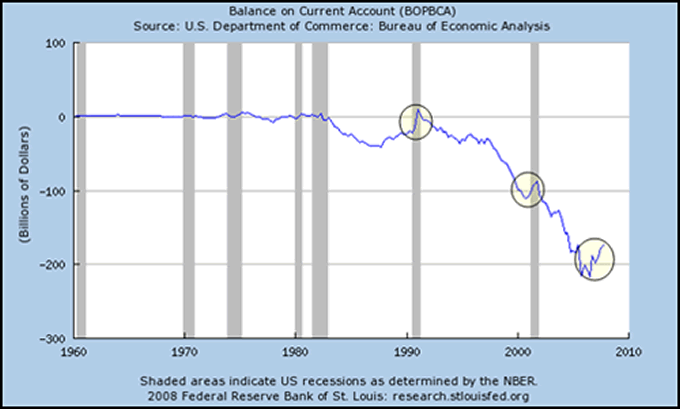
I recently read a report (sorry, in this case I forget where) that painted a sunny and optimistic outlook for sources of growth from emergent technologies. There can be little doubt that there is significant potential in such growth, but a larger question is whether such growth can reverse the ongoing contraction, and provide broad enough growth to replace the debt based economy. In particular, there is still an ongoing deficit in the balance of trade of goods and services. If you doubt the severity of the situation, you may wish to see the broader current account balance for the US here.

Whilst the deficits in the current account and trade are narrowing, this reflects that the US consumer is reigning in his/her spending, and such a contraction is therefore inevitable. The big question is as to whether this will eventually become a surplus, which is necessary if the US is to start repaying debt. In other words, the US needs to climb the mountain from deficits to surplus, before it can even start to repay debt. In light of the ongoing deficits for such a long period, this is a very tall proposition.

Meanwhile, the pile of consumer credit (i.e. a foregoing of future consumer spending) that is outstanding is quite monstrous, as can be seen in a chart here which shows $US 2500 billion outstanding (I use the Federal Reserve of St. Louis for much of the data in the post), and a chart here showing a rise in personal bankruptcy (albeit from a low base). Meanwhile, the savings rate is climbing from negative territory towards 5%, as individuals have realised that rainy days do indeed come about. The consumer is saving instead of spending, which is healthy in the long term, but means an ongoing contraction in the service economy.

As for a big driver of the credit bubble, the housing market, it continues its relentless decline, albeit that the rate of decline has slowed somewhat. At the same time there are reports of increases in consumer confidence, which are puzzling in light of the record contraction in consumer credit and the ongoing climbs in unemployment exceeding half a million a month (curiously the brief slow down in the pace of unemployment is being seen as a positive sign of recovery). Also, where might the consumer spending come from, if savings are increasing and credit contracting?

For business, manufacturing indexes have been in freefall, corporate tax growth is sharply negative (sorry for the idea of negative growth). Meanwhile investment is down sharply, as can be seen in this report:
Business investment contracted by a record 37.9 per cent, as firms scrapped expansion plans and axed jobs, pulling down overall output. GDP was also hit by a record $103.7bn (£70.2bn) reduction in inventories, or stockpiles of unsold goods – and while that accounted for 2.8 percentage points of the decline, it was hailed as good news by many economists.
I was hoping to provide statistics on bankruptcy, but could only find figures for 2008, which show growth in bankruptcy, albeit from a low baseline. However, there is no doubt that one of the key sectors in the US economy is in deep trouble, and that is the automotive industry. Whilst the government is keeping the industry on life support, it does not bode well for the wider state of the economy.

Bernanke is proposing that as inventories are restored, there will be some kind of recovery in the coming months. Whilst an undershoot on inventory sizes might lead to a brief upswing, it is difficult to see where renewed demand will actually come from, or at least demand that will possibly start to match pre-crisis levels. As for an underlying indicator of business health and confidence, commercial real estate is expected to be the next phase of the melt-down:
Schonberger: What's your outlook for the commercial real estate market?

Kemper: I think commercial real estate has yet to play out in the banking system.

I think that we've played out subprime largely, but I think that the same practices and the same players extended lost credit into the commercial real estate space in the past five years or so, and I think those losses are yet to be realized in the system.

Just as for consumers and businesses, the government has long been on a borrowing binge, with total debt now exceeding $US 11,000,000 million and the curve is (of course) rising rapidly. The Congressional Budget Office is predicting a further growth in debt of about $2 trillion in 2009, busting through the congressional debt ceiling of $US 12 trillion. The scale of the borrowing is simply astounding, and the debt is growing at a time of considerable economic contraction, and just as the baby boomer generation is set to retire. Quite simply, it is difficult to see how such levels of debt can be justified.

The nature of the government / Obama $US 787 billion bailout plan for the economy is such that it has been widely criticised for being highly political, and including various pet projects and so called 'pork barrel'. A typical criticism can be found here and another here:
"The stimulus bill was supposed to be about jobs, jobs and jobs, and it turned into spending, spending and more spending," Boehner said. "And then we've got this budget. ... And the fact is, we've got trillion-dollar deficits in his budget proposal for as far as the eye can see."
The criticism of the bailout appears to divide into two broad camps; those who say it is not enough and is directed into the wrong projects which will also take to long to enact, and those who just consider it wasteful and a burden on future generations. Perhaps the most worrying aspect of the bailout and growth in spending is the massive declines in income for the federal government, which can be seen on a chart here.

There is a more fundamental problem in the government attempts to spend its way out of trouble. Even if Keynesian economic policy is accepted (which is not the case in this blog), the increases in government spending would be difficult to square with Keynesian policy. One of the principles of the policy is to save during the 'good times' and spend during the 'bad times'. As can be seen on the earlier chart on government spending, the government had massively increased spending even before the economic crisis hit. There was also the equivalent of a stimulus in the form of the massive credit bubble that formed, such that the economy was subject to two artificial stimuli before the crisis hit. How spending on top of a credit bubble, and government debt binge might be justified is completely baffling.

In essence, what the massive government spending is seeking to do is return the economy to a level of activity that was itself dependent on the credit bubble and excess government spending. In other words, all the stimuli are aimed at returning the US economy to a position which was of itself inherently unsustainable. Is this a Keynesian stimulus? I think it would be hard to describe it as such.

The real tragedy in all of this is that the Federal Reserve has also chosen to lend support for the economy through quantitative easing (printing money), with this from the FOMC:
To provide greater support to mortgage lending and housing markets, the Committee decided today to increase the size of the Federal Reserve’s balance sheet further by purchasing up to an additional $750 billion of agency mortgage-backed securities, bringing its total purchases of these securities to up to $1.25 trillion this year, and to increase its purchases of agency debt this year by up to $100 billion to a total of up to $200 billion. Moreover, to help improve conditions in private credit markets, the Committee decided to purchase up to $300 billion of longer-term Treasury securities over the next six months.
The Federal Reserve is now embarking on a great experiment in monetary policy, and pumping ever more $US into the world economy. A good way to get a grip on the massive increase in the monetary base that is taking place is to look at the chart here, which gives an excellent sense of the dramatic increases taking place.

An underlying principle of such a policy is that, as soon as the economy tends towards inflation, the expansion in the money supply will be reversed by selling the assets accumulated by the Federal Reserve, and thereby destroying the money. This all sounds fine in principle, but the US government is, for example, already selling huge amounts of treasuries. As such, the Federal Reserve will add to the flood of treasuries already entering the market as soon as it attempts to reverse the money printing policy. There are already rumblings about the extent of the issue of treasuries from China, as well as concerns that the printing of money will inflate away the value of the $US:

“A policy mistake made by some major central bank may bring inflation risks to the whole world,” China’s central bank said in the report today. “As more and more economies are adopting unconventional monetary policies, such as quantitative easing, major currencies’ devaluation risks may rise.”

Chinese Premier Wen Jiabao expressed concern in March that the dollar will weaken, eroding the value of China’s holdings of Treasuries, as the U.S. borrows unprecedented amounts to spend its way out of recession. China’s Treasury holdings climbed 52 percent in 2008 and stood at about $744 billion as of the end of February, according to U.S. government data.

We also have an article in the Financial Times, which suggests that the $US is set for a major fall if China finally loses faith in the currency:

US policy is pushing China towards developing an alternative financial system. For the past two decades its entry into the global economy rested on providing cheap labour to multinationals and pegging the renminbi to the dollar. The dollar peg allowed it to leverage the US financial system for its international needs, while domestic finance re-mained state-controlled to redistribute prosperity from the coast to the interior. This dual approach has worked well. China could have its cake and eat it. Of course, the global credit bubble was what allowed the approach to be effective; its inefficiency was masked by bubble-generated global demand.

China is aware it must become independent from the dollar at some point. Its recent decision to turn Shanghai into a financial centre by 2020 reflects its anxiety over relying on the dollar system. The US will not pay attention to something so distant. However, if global stagflation takes hold, as I expect it to, it will force China to accelerate reforms to float its currency and create a single, independent and market-based financial system. When that happens, the dollar will collapse.

The problem might be summarised as follows. The US government is borrowing gargantuan amounts of money at a time when the economy is in freefall, and at a time when the government had already racked up massive debts through spending too much. All the while that the government was racking up debts, consumers and businesses were doing the same. The result of this were massive imbalances in the economy which created an unsustainable boom, with continual current account and trade deficits. Essentially, much of the US economy has been supported by this massive accumulation of deficits.

However, as the consumer deficit spending evaporates with the crash in house prices, the US government and Federal Reserve are acting to reverse the loss of unsustainable consumer spending through massive expansion in money, and even greater fiscal deficits. They are making no serious attempts to reverse the deficits, and have no clear plan for how both the government and wider economy might move from deficit to surplus. The recent 'austerity' being proposed by the Obama administration is quite simply pathetic, and will do nothing for the credibility of fiscal policy:

The effort to turn attention to fiscal austerity follows a three-month period in which Obama signed a $787 billion economic stimulus package and a $410 billion spending bill to complete the 2009 budget. The stimulus package includes funding for flood prevention and wastewater treatment programs Obama now says should be eliminated.

His 1,374-page budget for 2010 includes more than $1.2 trillion in funds that must be appropriated by Congress, including big increases in health care, energy and education. The contrast between the proposed new spending and reductions produced derision from Republican critics.

"It's like taking a teaspoon of water out of a bathtub while you keep the spigot on at full speed, and the bathtub continues to fill up," said Sen. Judd Gregg, R-N.H., who Obama tried earlier this year to nominate as Commerce secretary.


For creditor nations such as China, it must increasingly look like the US is initiating the largest default in history - through the destruction of the value of the debts through inflation.

If we then look at US GDP to gain an overview over recent months, the figures are quite simply dire:

The U.S. economy contracted at a steeper-than-expected pace of 6.1 percent in the first quarter, weighed down by sharp declines in exports and business inventories, according to government data on Wednesday that showed the economy was still deep in recession. [nN28309952]

The figure was weaker than analysts' forecasts of a drop of a 4.9 percent rate, according to a Reuters poll, and it also meant output now has declined for three straight quarters for the first time since 1974-1975. U.S. stock futures trimmed gains but still pointed to a higher open. [ID:nN29390529].

It is also important to understand that GDP is a measure of activity in the economy. As such, the figure is itself misleading as an indicator of economic health. For example, borrowed money creates activity, and this is included in the figures. As such, the GDP fall is taking place despite massive increases in government borrowing, which will have increased activity within the economy.

At the moment it is not hard to find optimistic projections for an economic recovery from many in the mainstream media, as well as from government sources. However, if we look at each sector of the economy, the only possible brightspot is a slight upswing in inventories. The idea that the economy might cease contraction overall is very dubious, although the money printing and fiscal stimulus might give a brief appearance of improvement. The trouble with these activities is that they are endangering the value of the $US, through the massive expansion of debt and the potentially inflationary increase in the issuance of the $US.

I received considerable criticism across the web for my predicted collapse in the $US, in particular for getting the time frame wrong. However, as each week goes by, the strains on the $US just seem to increase. The economy is still in freefall; many banks are still insolvent (whatever the stress tests might suggest), unemployment is rising, saving is rising (less consumer spending), businesses are failing, the housing market is falling, businesses are failing, personal bankruptcy is climbing, government deficits are increasing, GDP is falling, manufacturing is declining, commercial real estate is expected to plunge, record amounts of money are being printed, and overseas creditors are becoming ever more cynical.

Overall, it does not paint a very pretty picture. Somehow, people are still managing to be positive and optimistic about the US economy. This is a bit of a puzzle.


Note 1: An interesting debate followed from the post of Lord Keynes. As ever, he offered a well considered contribution, and this was recognised by many of the commentators. As a personal note, I would like to thank him for his effort and contribution, not just for the post, but for his many comments on my own posts. I would also like to thank the many others who contribute comments, which make this blog a lively destination.

Note 2: A review of the US economy proved to be quite challenging. In some respects, there is just too much information. In such a situation there is the possibility of selective bias. As such, if you feel that you have information that contradicts what I have outlined, please feel free to link to the source. I have also, in some cases chosen sources for convenience, and this is simply a matter of the time that I can put in to each post. If you have better sources, again, please feel free to post links. One of the great aspects of the comments on the blog is that commentators often turn up both interesting sources, and some interesting points of view.

Note 3: I did think about waiting for the stress tests before publishing, but decided that the nature of the tests was such that their only importance was in their impact upon confidence. As such I published sooner rather than later.

Monday, May 4, 2009

Guest Article: Economics and Ethics

Introduction:

I mentioned in previous notes on posts that one of the regular commentators, 'Lord Keynes', would be given the opportunity to post on the blog. Lord Keynes is one of the regular commentators, and often writes a considerable amount of material, which is always well researched and well considered. However, many of the comments that are made run counter to the general thesis of this blog, and have proved to be controversial with other commentators. As such, in the spirit of generating debate, I have offered Lord Keynes an open remit to write a post on any subject, and his post can be found below. I hope that it proves to be of interest, and look forward to the insightful commentary that usually follows my own posts. The post, on ethics and economics, now follows:

Economics and Ethics

Whatever economic system you advocate (e.g., libertarianism, free market economics, neo-liberalism, social democracy, democratic socialism, communism etc), in intelligent debate you should be able to justify that system by appealing to some philosophical or ethical theory, if you want to convince other people of the morality or superiority of your system and your arguments.

In the end, this comes down to choosing an ethical/moral theory, a system that explains your view of morality: that is, why actions are right or wrong.

The only effective theories available to justify a larger philosophical system in a consistent way are objectivist theories of ethics (that is to say, a subjectivist or relativist theory of ethics is self-defeating).

In essence, an objectivist theory of ethics holds that:

– moral judgements are propositions that have an objective value, either true or false (e.g, “The unjustified killing of another human being is wrong”);
– the truth of a moral proposition remains true regardless of the subjective opinions of a person or the values of a different culture (e.g., “Slavery is wrong”);
– morality is not subjective or relative.

If we want an objectivist theory of our morality, we essentially have these options:

Moral Objectivist Theories of Ethics:

(1) Moral absolutism
(a) Divine Command Theory
(b) Categorical Imperative ethics (Kantian ethics)

(2) Moral Universalism (also called minimal or moderate moral realism)
(i) Deontological theories:
(a) Natural law theories (Plato and many Christian philosophers)
(b) Thomist ethics
(c) Pluralistic deontology, the non-absolutist ethics of W.D. Ross
(d) Human rights objectivism (Rawls)
(ii) Consequentialist theories:
(e) Utilitarianism (act utilitarianism; rule utilitarianism)
(f) Ayn Rand’s objectivism?
(iii) Ayn Rand’s objectivism?

(3) Utilitarian Kantian Principle of James Cornman (combines deontology and utilitarianism

All of these objectivist theories of morality/ethics can be divided into 2 basic groups as follows:

(1) Deontological theories (= duty or obligation based morality): the basis of morality is duty and some acts are always right no matter what consequences they can cause (the best example of which is Kantian ethics or some forms of divine command theory; Kant famously said that it is always wrong to lie, no matter what the circumstances).

(2) Consequentialist theories: the basis of morality is the evaluation of the consequences of acts on people (the most famous such theory is Utilitarianism). The greatest happiness of the greatest number of people is one way of describing it.

(I will not address the question whether Ayn Rand’s objectivism is consequentialist or in a category by itself, since this is disputed.)

Use your intuition and find out whether you subscribe to (1) a duty-based ethical theory or (2) a utilitarian or consequentialist ethical theory by thinking about this moral problem:

A known murderer comes to you and asks to know where a person he wants to kill is, and you are aware of his desire to commit murder. Do you:

(1) Lie to protect the innocent person and say you do not know, or
(2) Tell the murderer where that person is in the knowledge that a murder may
occur?

Decision (1) makes you a utilitarian, and (2) a believer of duty-based ethics. Immanuel Kant, although it hard to believe, held that (2) is the moral course of action, since lying is always immoral, under all circumstances.

Ethics as Applied to Economics

Divine command theory is easily refuted: e.g., if god orders someone to commit genocide, then this suddenly becomes a “moral” action, because God has ordered it. Thus divine ethics turns out to be a subjective theory of ethics: what is moral and what is not actually depends, in the end, on the arbitrary whim of God, not the goodness of actions or their consequences. (Kantian ethics was in fact partly an attempt to create an objectivist ethics that could defend Christian morality, but remove this problem by basing morality on moral principles derived from human reason.)

Many libertarians rely on a natural law/natural rights theory of ethics.

Thus they often argue that state intervention is bad when it violates private property rights, and that this government action is always immoral, irrespective of the good or bad consequences that state intervention has or may have.

Natural law as a theory can be traced back to Plato, the ancient Stoics, and many Christian philosophers. (Contrary to popular belief, the most widely-held theory of ethics in the Middle Ages in Christian philosophy was the natural law theory, not the crude divine command theory.)

Natural law was famously attacked by the English utilitarian philosopher Jeremy Bentham as “nonsense on stilts.”

One of the main weaknesses of natural law theory is that its main historical justification was the belief in a “divine order” and a divinely-created human nature that makes us conform to “natural law.”

For Plato, the divine soul made human beings conform to the natural law of the universe. In ancient Stoicism, all humans had a divine reason given by the gods to make them adhere to divine “natural law.”

When natural law theory was taken up by Christian theologians, they simply substituted the Christian god for the gods of the Greek and Romans.

In the early modern period, rationalist European philosophers like Grotius tried to defend natural law theory by removing God and the previous supernatural justification for it.

However, in doing so, they destroyed the only convincing explanation for belief in natural law (Tawney 1998: xxv-xxvi).

Thus anyone who accepts an atheistic and naturalistic scientific view of the universe, and who rejects all religion, has no reason to believe in natural law or natural rights.

It follows that all modern types of libertarianism or free market economics based simply on a “natural law” or “natural rights” foundation are severely flawed systems (e.g., the systems of Adam Smith or Murray Rothbard).

There is no reason to believe that the “natural law” that justifies placing inviolable property rights at the centre of our modern political or economic systems has any validity whatsoever.

In my opinion, Kantian ethics has no real consequences for economics: it can be used to justify numerous economic systems and is fully compatible with social democracy.

However, Kantian deontological ethics has severe problems.

A better ethical theory, in my view, is a modern form of utilitarianism called rule utilitarianism (which is quite different from its crude early form as advocated by Jeremy Bentham).

Some libertarians or advocates of free market economics actually do use utilitarian arguments to justify their positions and economic systems (e.g., Ludwig von Mises, the earlier Friedrich von Hayek [Gregg 2003: 21-22], and Milton Friedman [Frederick 2002: 23]).

Thus anyone who uses a utilitarian argument to support ideas about economics will ultimately have to examine the good and bad effects of the policies they advocate.

In these theories, there is no a priori reason why state intervention could not in principle be moral and successful.

Any economic argument, then, essentially becomes an argument about empirical reality: the consequences of economic policy today and in the past.

The good consequences of state intervention and social democracy for the greatest number of people in society fully justify these policies.

Of course, philosophical objections have been raised to utilitarianism.

One solution may be that we should adopt James Cornman’s Utilitarian Kantian Principle of ethics: this (as I understand it) has caused a great deal of excitement amongst modern philosophers, because it combines the best elements of Kant’s deontological ethics with utilitarianism. It is perfectly compatible with state intervention in economics.


BIBLIOGRAPHY

Frederick, R. 2002. A Companion to Business Ethics, Blackwell, Malden, Mass.

Gregg, S. 2003. On Ordered Liberty: A Treatise on the Free Society, Lexington, Oxford and Lanham, Md.

Scruton, R. 1994. Modern Philosophy: An Introduction and Survey, Penguin Books, London.

Tawney, R. H. 1998. Religion and the Rise of Capitalism, Transaction, New Brunswick, N.J. and London.

J. W. Cornman, K. Lehrer, and G. S. Pappas. 1992. Philosophical Problems and Arguments: An Introduction, Hackett, Indianapolis.